Identifying frequency-domain operating deflection shapes and internal damage in structures using geometric vision method
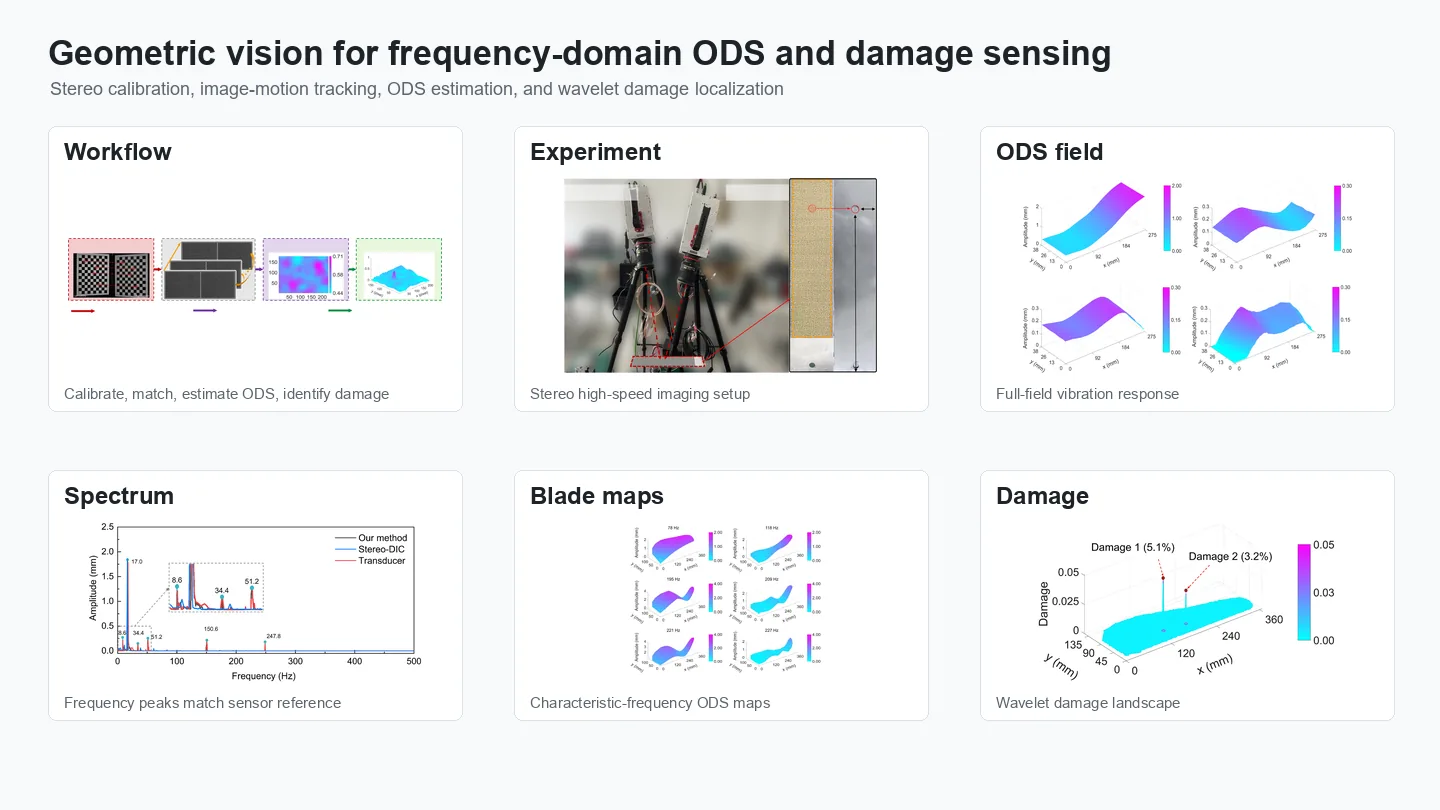
In one sentenceTwo synchronized high-speed cameras turn image motion into full-field vibration shapes in the frequency domain, and a wavelet scan of those shapes locates hidden internal damage without contact sensors or excitation data.
The problem
An operating deflection shape (ODS) describes how a structure deforms at each vibration frequency while it is in service. Because it does not require prior knowledge of the excitation, it offers an automatic way to assess dynamic behaviour and to detect damage. Measuring it is the hard part. Conventional contact sensors are bulky in operation and serve a single function, and non-contact laser vibrometers sample one point at a time and need complex calibration, which is impractical when many degrees of freedom are involved. Vision methods can measure dense surface motion, but stereo digital image correlation (stereo-DIC), which tracks speckle points across images and triangulates them, reconstructs displacement in the time domain first, where noise has to be filtered out and the filtering can remove high-frequency motion as well. Earlier frequency-domain triangulation methods use one camera that sees the object from several views through relative motion, so camera poses change between views, must be re-estimated at every step, and introduce phase delays.
Internal damage adds a second difficulty. Visual crack detection only sees surface defects, while vibration-based damage identification usually needs precise excitation information or contact sensors, and recent vision-based variants still rely on pseudo-excitation or heuristic steps such as denoising and clustering.
How it works
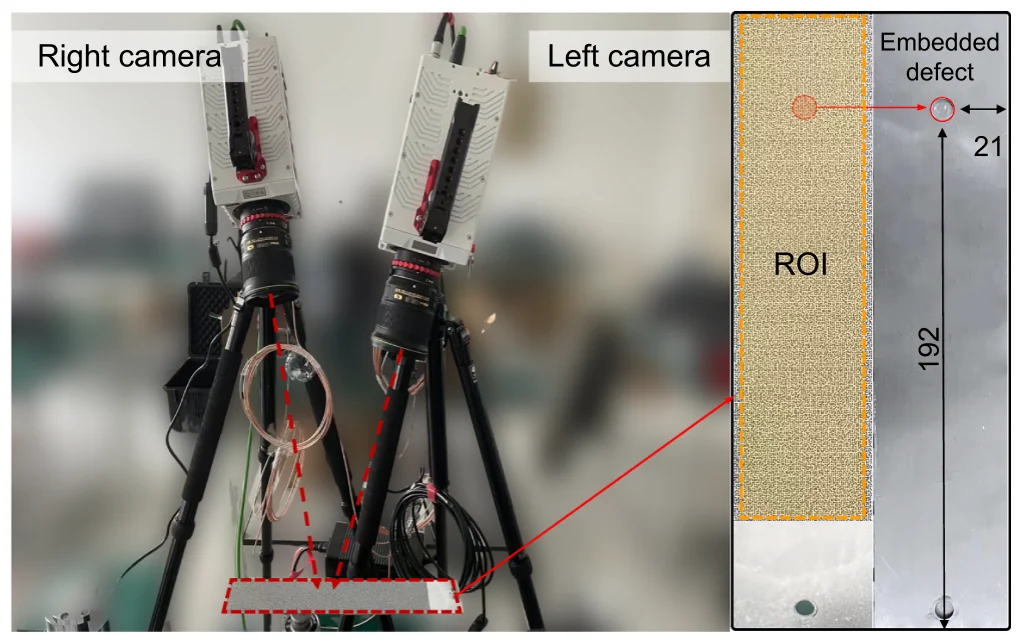
The method uses a stereo pair of still high-speed cameras with a fixed geometry. After calibration and rectification, every observed point is described by one parameter, its disparity, which makes the map from stereo image motion to the frequency-domain ODS linear. A wavelet transform of the resulting ODS fields then exposes internal damage.
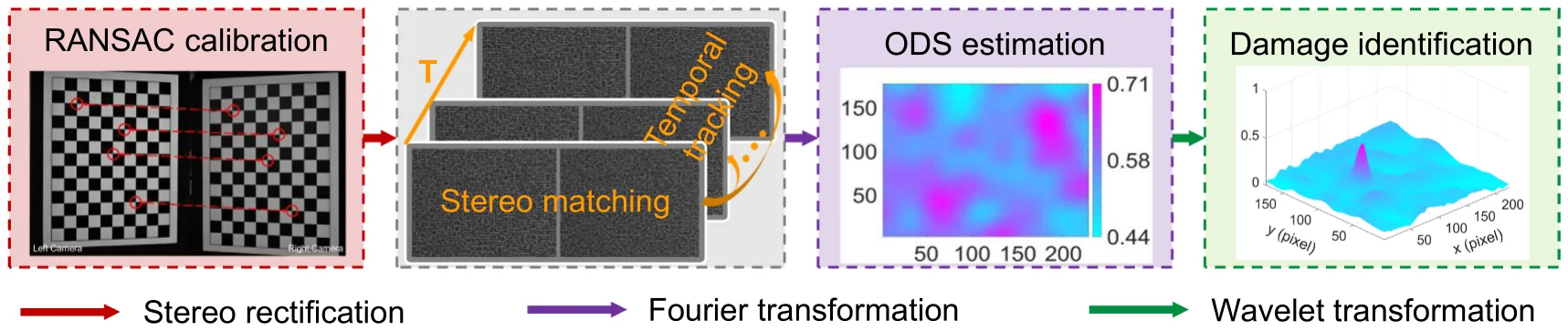
- RANSAC calibration. Zhang’s planar-target method runs inside a RANSAC loop: random subsets of checkerboard corners are used for calibration until the averaged re-projection error meets a threshold. Corners that lose imaging precision in some poses therefore no longer bias the focal lengths, principal points and distortion factors.
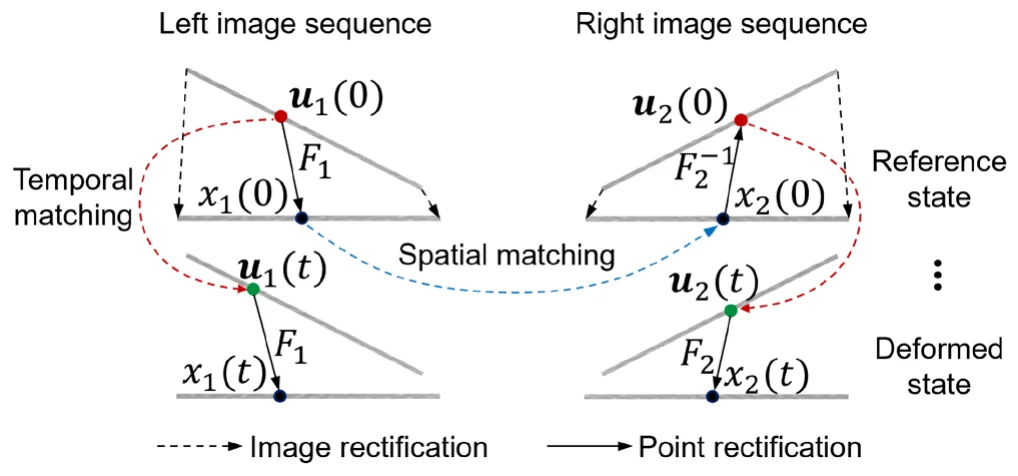
- Stereo and temporal matching. Only the reference stereo pair is rectified. Each point of interest is matched along the epipolar line with spatial DIC, then tracked through the original left and right image sequences with temporal DIC. Rectification is applied to the tracked point coordinates rather than to whole images, which avoids interpolation errors.
- Depth parameterization. In the rectified geometry a point’s depth is d = Bf/δ, with baseline B, focal length f and disparity δ, so each point has one unknown instead of three. Its image motion is encoded in a state vector ξ(t) = x₁(t)/δ(t), where x₁(t) is the point’s image coordinate in the left camera.
- ODS in the frequency domain. The ODS is a linear function of the state-vector change, U(ω) = Bf · Δξ(ω), obtained with a discrete Fourier transform and no triangulation step. The ODS fields at all frequencies form the response spectrum, and each peak corresponds to a full-field ODS map.
- Wavelet damage identification. Each ODS field is treated as an image on the left reference grid. Damage due to stiffness loss shows up as a step in the ODS, and a Haar wavelet transform produces normalized coefficients that peak at the damage. The peak gives the location and the damage degree, a relative change in ODS amplitude that reflects the local stiffness loss.
Results
The test specimen is a 1.5 mm thick, 300 mm × 50 mm plate of 304 stainless steel with a blind hole, 8.0 mm in diameter and 1.0 mm deep, on the face the cameras do not see. An exciter drove it at 17 Hz, close to its first natural frequency, while the two cameras (2560 × 1920 pixels) recorded 5000 stereo pairs at 1000 fps. RANSAC calibration lowered the re-projection error from 0.088 to 0.039 (Table 2) and the mean 3D error of an 8 × 8 test target from 0.124 mm to 0.013 mm (Table 3). On the flat specimen, the depth error ranged from −0.06 to 0.09 mm (mean 0.02 mm), against −0.17 to 0.35 mm (mean 0.09 mm) with Zhang’s calibration (Fig. 6).
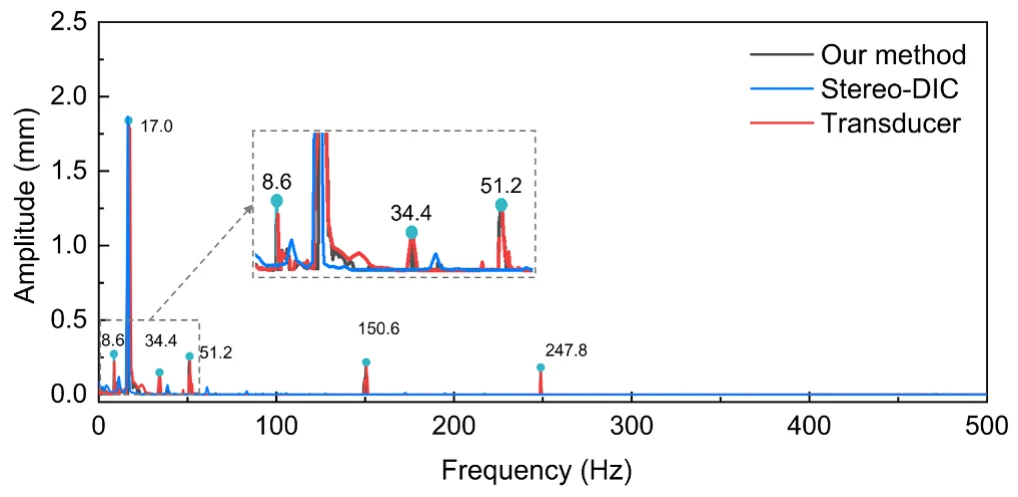
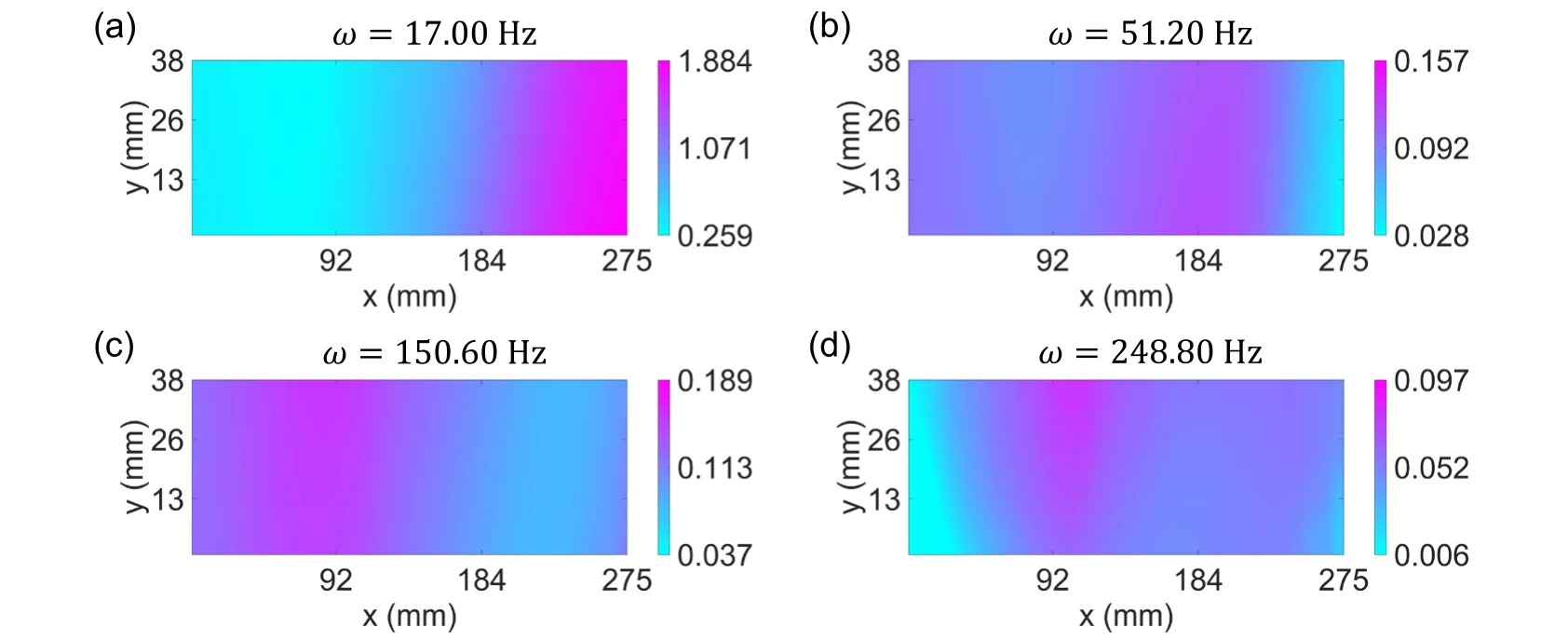
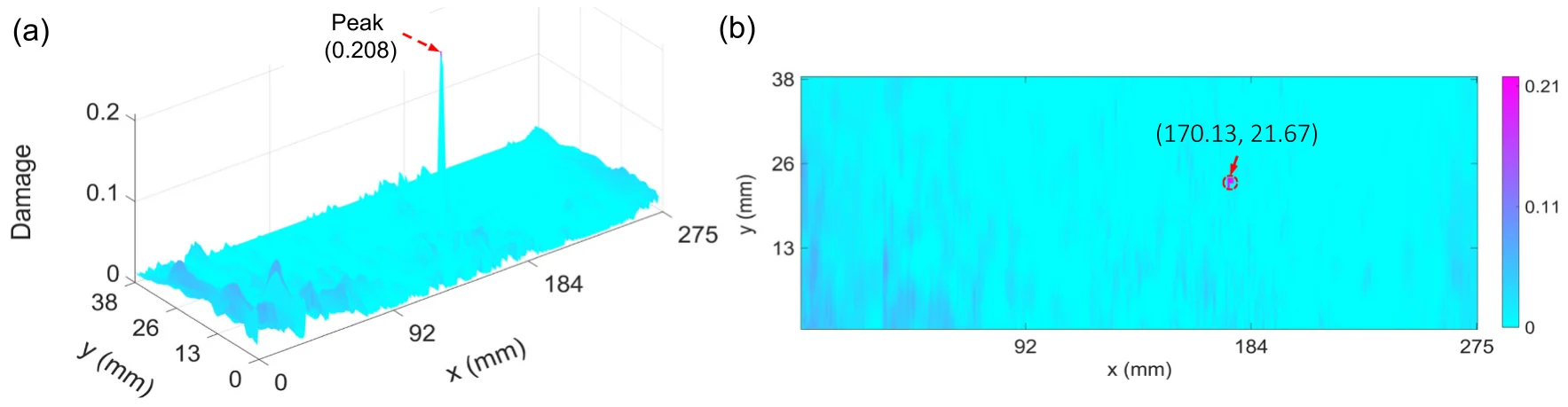
At the transducer location, the vision-based spectrum captured the complete set of peaks. Even at 34.4 Hz, the smallest amplitude of 0.14 mm was estimated within 0.01 mm, while stereo-DIC missed most of the components other than the resonance. The full-field ODS maps at 17.0, 51.2, 150.6 and 248.8 Hz show the amplitude falling and the shape growing more complex as frequency rises, and singular value decomposition of these fields gives the corresponding 3D mode shapes. The wavelet damage landscape peaked at 0.208; transformed to the specimen frame, the damage lies at (24.26, 195.13) mm against the actual (25.00, 196.00) mm.
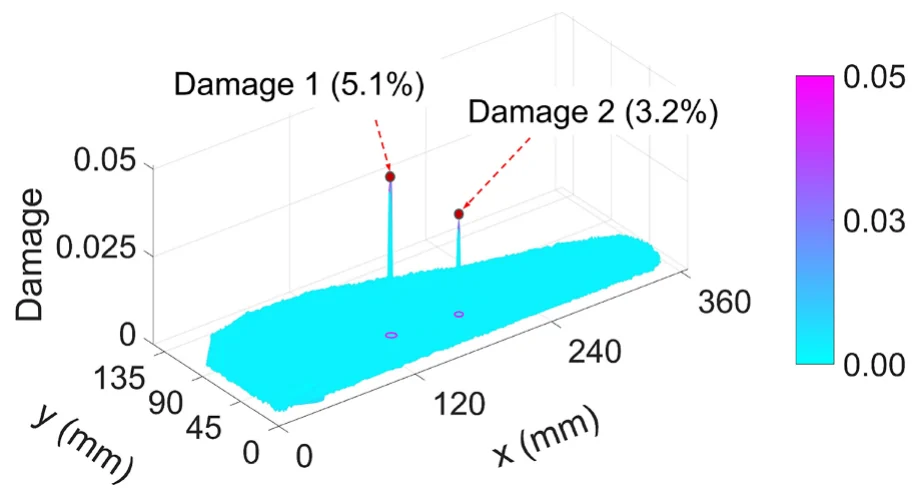
The method was also applied to a 3D-printed resin blade with curved surfaces, a 340 mm chord and two internal defects (5 mm and 3 mm in diameter, 0.8 mm and 0.6 mm deep) under a 0–300 Hz sweep excitation. Spectra at three points along the chord gave six characteristic frequencies, and the corresponding ODS maps yielded the first six mode shapes without excitation information. Both defects were found, with damage degrees of 5.1% and 3.2% and maximum positioning errors of 1.08 mm and 1.11 mm.
The authors note two limits. The two separate cameras used here are not integrated enough for long-term monitoring, and they propose a compact biprism stereo optic as a path forward. The damage algorithm recovers the location and extent of internal damage but not its shape or orientation.
Cite
@article{zhang2025identifying,
  title={Identifying frequency-domain operating deflection shapes and internal damage in structures using geometric vision method},
  author={Zhang, Haoran and Zuo, Jiaren and Yao, Zhangyu and Zhang, Deyang and Lu, Lei and Pan, Wei and Su, Zhilong},
  journal={Results in Engineering},
  pages={108474},
  year={2025},
  publisher={Elsevier},
  doi={10.1016/j.rineng.2025.108474}
}