Calibration Method of Fringe Projection Based on High-Order Polynomial
In one sentenceA faster way to calibrate fringe-projection 3D scanners: fit a high-order polynomial phase-to-3D model with a sparse greedy randomized Kaczmarz solver, in under half the time of least squares and with higher accuracy.
The problem
Phase-shifting profilometry (PSP) measures 3D shape by projecting sinusoidal fringes onto an object, recovering the phase of the deformed fringes in the camera image, and converting pixel coordinates and phase into 3D coordinates. That conversion is set by system calibration, and the traditional approaches are laborious. Phase-to-height mapping needs a large, precise calibration target and a precision translation stage, and its parameters depend on how accurately both are made and moved. Stereo-vision calibration takes the target coordinates and their image coordinates in the camera and the projector, and solves for the parameters by nonlinear optimisation. That is slow, and the accuracy depends on how well those image coordinates are measured.
A polynomial calibration model avoids the projector model and the translation stage: it directly fits the 3D world coordinates as a polynomial in the pixel coordinates (u, v) and the absolute phase ϕ. Higher orders describe this relationship more accurately, but the number of coefficients grows quickly, and fitting them by least squares becomes slow and unstable once the order exceeds 3. An earlier simplification removes redundant terms by principal component analysis, which speeds the fit up but lowers reconstruction accuracy.
How it works
The method keeps a high-order polynomial calibration model, which needs no projector model and no translation stage, and replaces least-squares fitting with a sparse greedy randomized Kaczmarz (SGRK) solver. SGRK combines the efficient iterations of the randomized sparse Kaczmarz method with the selection strategy of greedy algorithms: each step works on one well-chosen equation instead of the whole system.
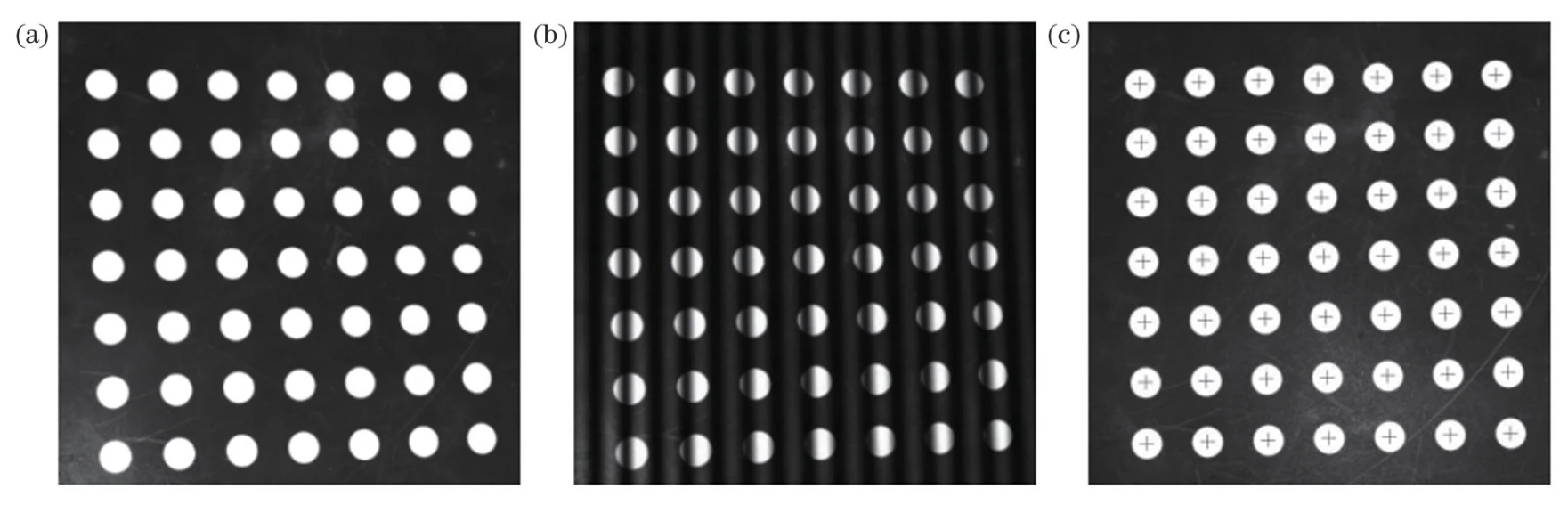
- Collect calibration points. Fringes are projected onto a circle-grid board placed in several poses. The circle centres are the feature points: each gives its pixel coordinates (u, v), its absolute phase ϕ from three-frequency four-step phase shifting, and its world coordinates from Zhang’s calibration method.
- Set up the polynomial model. Each world coordinate X, Y and Z is written as an n-th order polynomial in u, v and ϕ, so calibration becomes a linear system W = Ax. The model has 60 coefficients at order 3, 105 at order 4 and 168 at order 5; the paper uses order 4 as its standard model, balancing accuracy and computing time.
- Choose an equation greedily. In each iteration SGRK computes the residual of every equation, keeps the rows whose residual exceeds a threshold, and draws one of them with probability proportional to its squared residual. Equations with large errors are therefore updated first, which speeds up convergence.
- Update and sparsify. The chosen row updates the coefficients by a weighted Kaczmarz projection, and a soft-threshold operation then sets small coefficients to zero, so the solution stays sparse.
- Iterate, then reconstruct. The loop runs until the relative standard error (RSE) of the coefficients falls below 10⁻⁶. To measure an object, the pixel coordinates and absolute phase of each point are put into the fitted polynomial to give its 3D coordinates.
Results
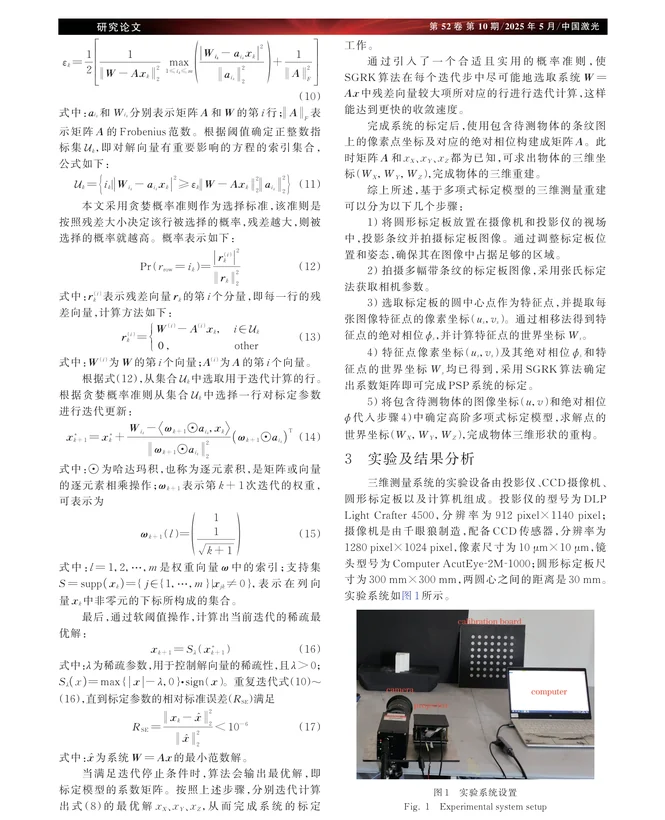
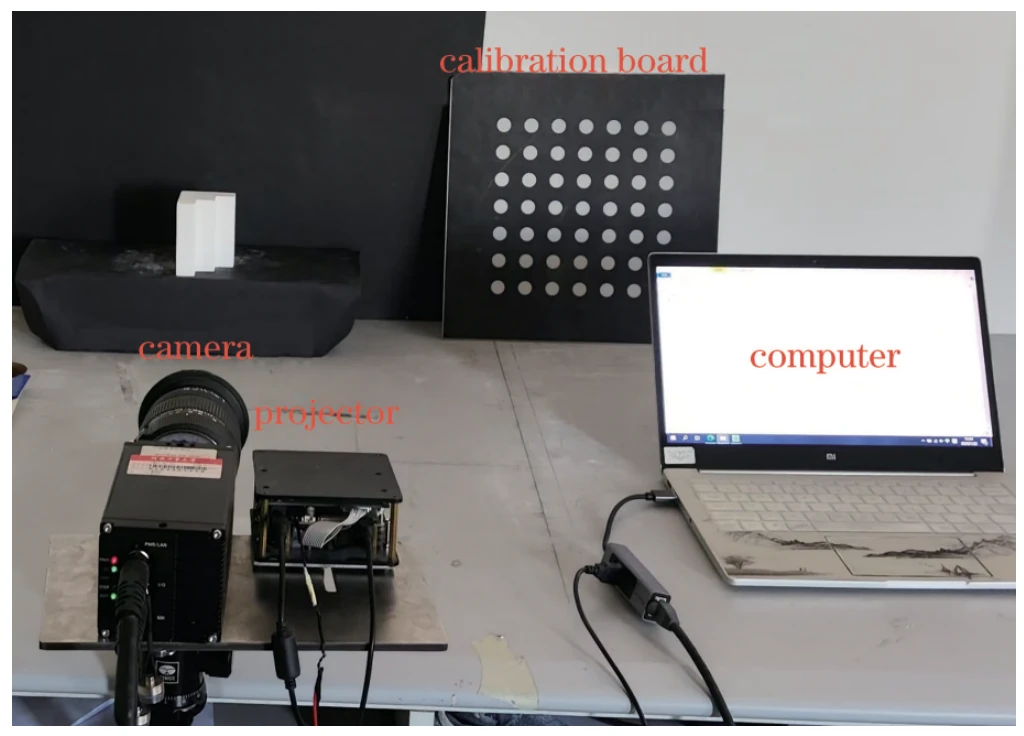
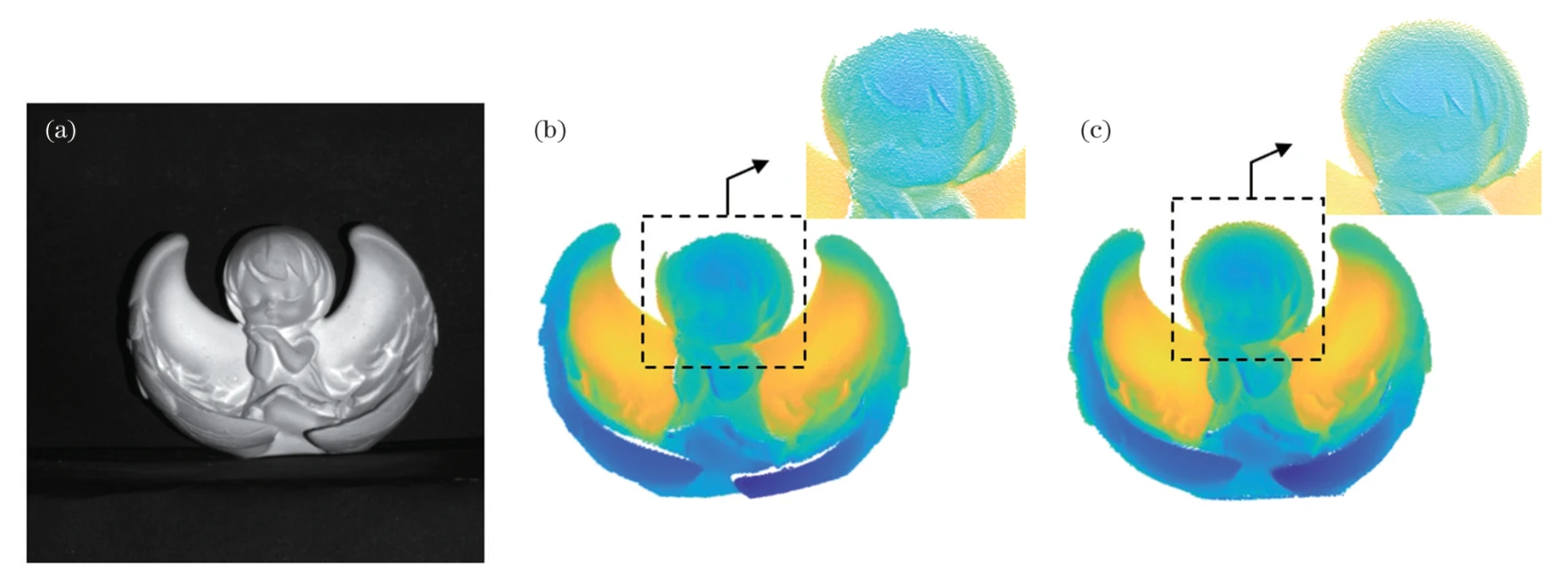
The system uses a DLP LightCrafter 4500 projector (912 × 1140 pixels), a CCD camera (1280 × 1024 pixels) and a 300 mm × 300 mm circle board with 30 mm between circle centres. Each method was compared on the full 4th-order model and on the PCA-simplified 4th-order model. SGRK was faster and more accurate in both cases: on the sphere the simplified model gave 0.0449 mm in 1.17 s with SGRK against 0.0932 mm in 3.17 s with least squares, and the simplified models were less accurate than the full one for both solvers (Table 2). The step block was measured three times after each calibration to check repeatability (Table 1).
The advantage holds at other orders too (Table 3). At order 3, SGRK gave a sphere diameter deviation of 0.0549 mm in 1.02 s against 0.1470 mm in 3.04 s for least squares; at order 5, 0.0177 mm in 2.31 s against 0.0400 mm in 6.15 s. The 5th-order model is more accurate than the 4th, but its 168 coefficients make the computation markedly longer, and both are more accurate than the 3rd-order model.
Cite
@article{张庆辉2025基于高阶多项式的条纹投影标定方法,
  title={基于高阶多项式的条纹投影标定方法},
  author={张庆辉 and 黄婷婷 and 吕磊 and 潘威 and 郑万兴 and others},
  journal={Chinese Journal of Lasers},
  volume={52},
  number={10},
  pages={1004002--1004002},
  year={2025},
  publisher={中国激光杂志社},
  doi={10.3788/cjl241279}
}