Plasmon-induced transparency in coupled triangle-rod arrays
In one sentenceA gold nanotriangle, driven by light, excites a dark multipolar mode in a nearby nanorod; their interference opens a narrow transparency window, which the gap and the sideways offset of the rod control.
The problem
Electromagnetically induced transparency (EIT) is a quantum interference effect that removes light absorption in an atomic medium. It opens a spectrally narrow transmission window with extreme dispersion, which is attractive for sensing and slow light. Plasmonic nanostructures can mimic it with classical field interference, an effect called plasmon-induced transparency (PIT). PIT involves strong coupling between two distinct plasmon modes in one unit cell: a highly radiative “bright” mode with a broad resonance, and a subradiant “dark” mode with a narrow one. Their destructive interference gives a narrow transparency window.
The unit cell is the building block of plasmonic molecules and metamaterials, and small structural variations from fabrication errors can significantly degrade its optical function. This paper studies a coupled triangle-rod unit cell: it identifies the bright and dark resonators, and measures how the PIT window changes when the geometry is varied in small, controlled steps.
How it works
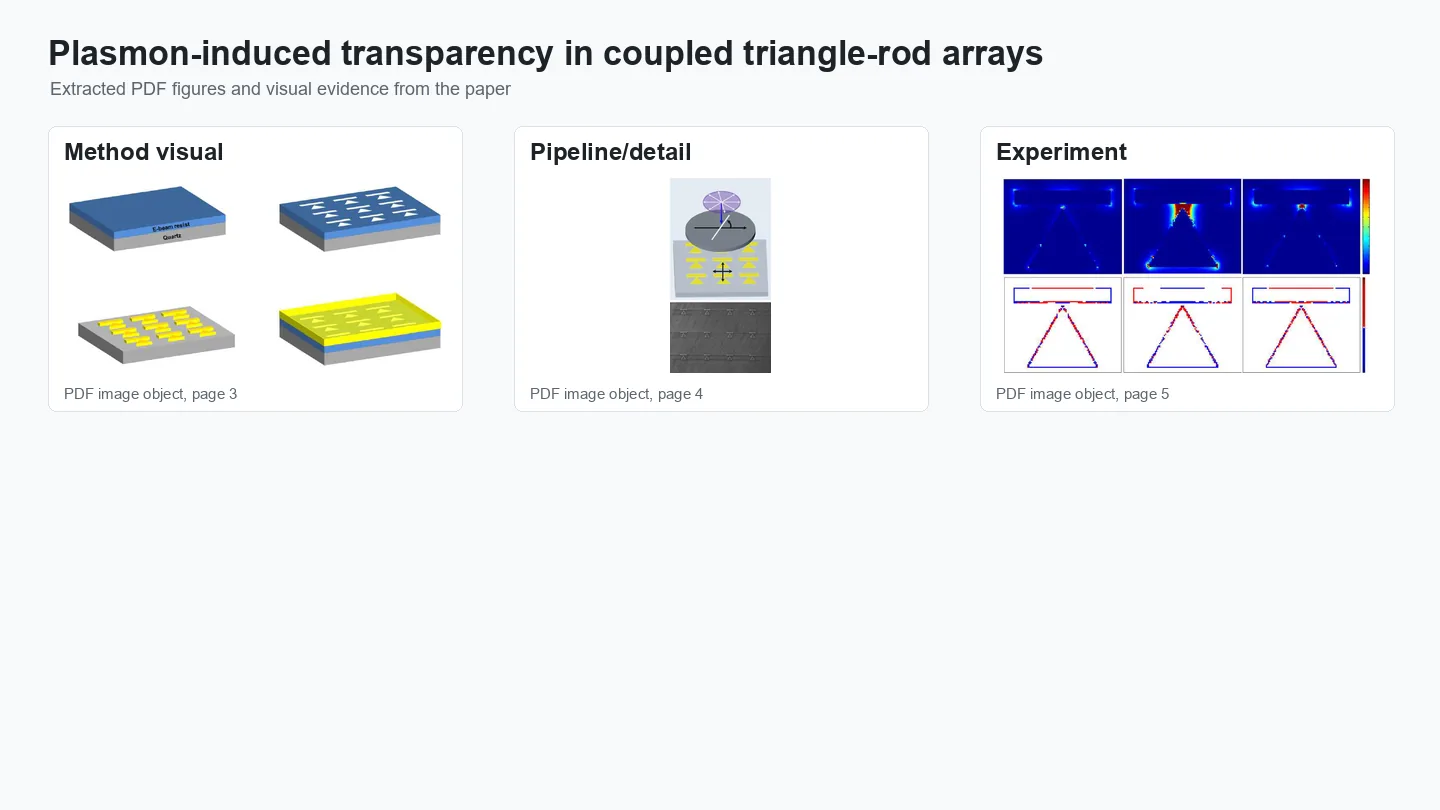
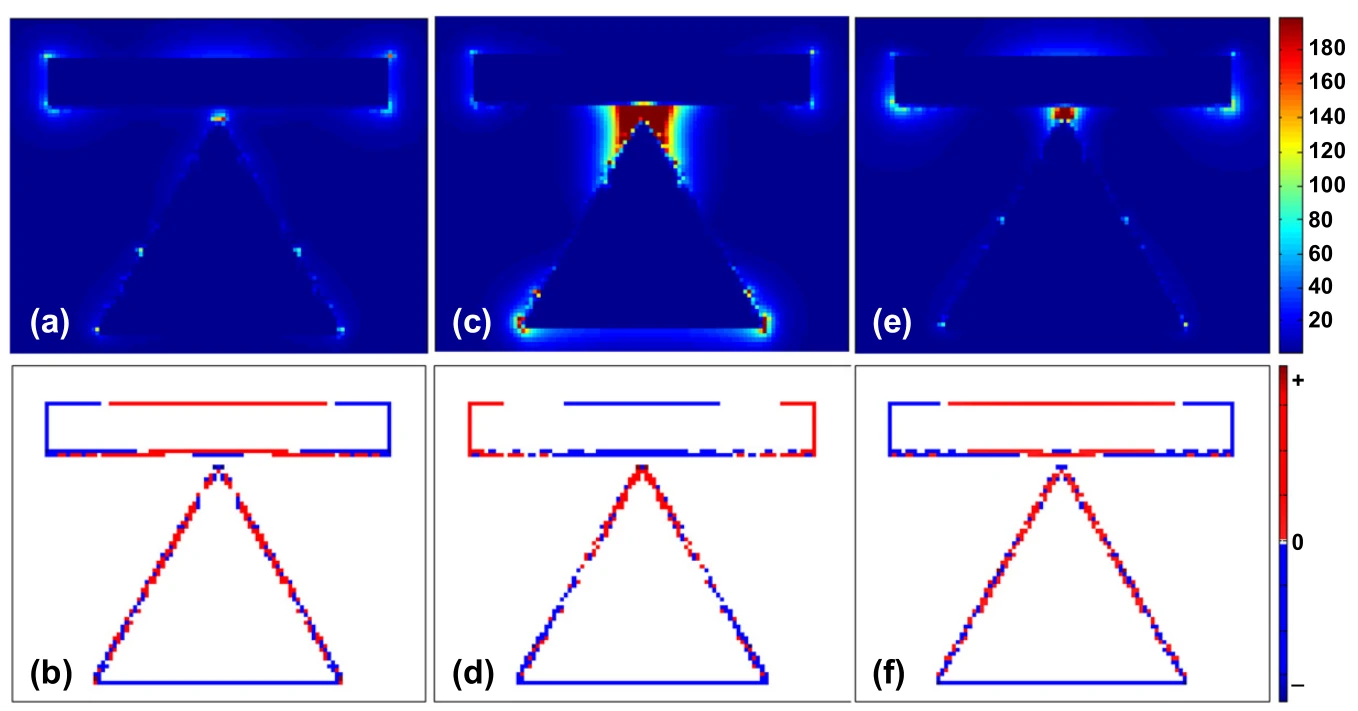
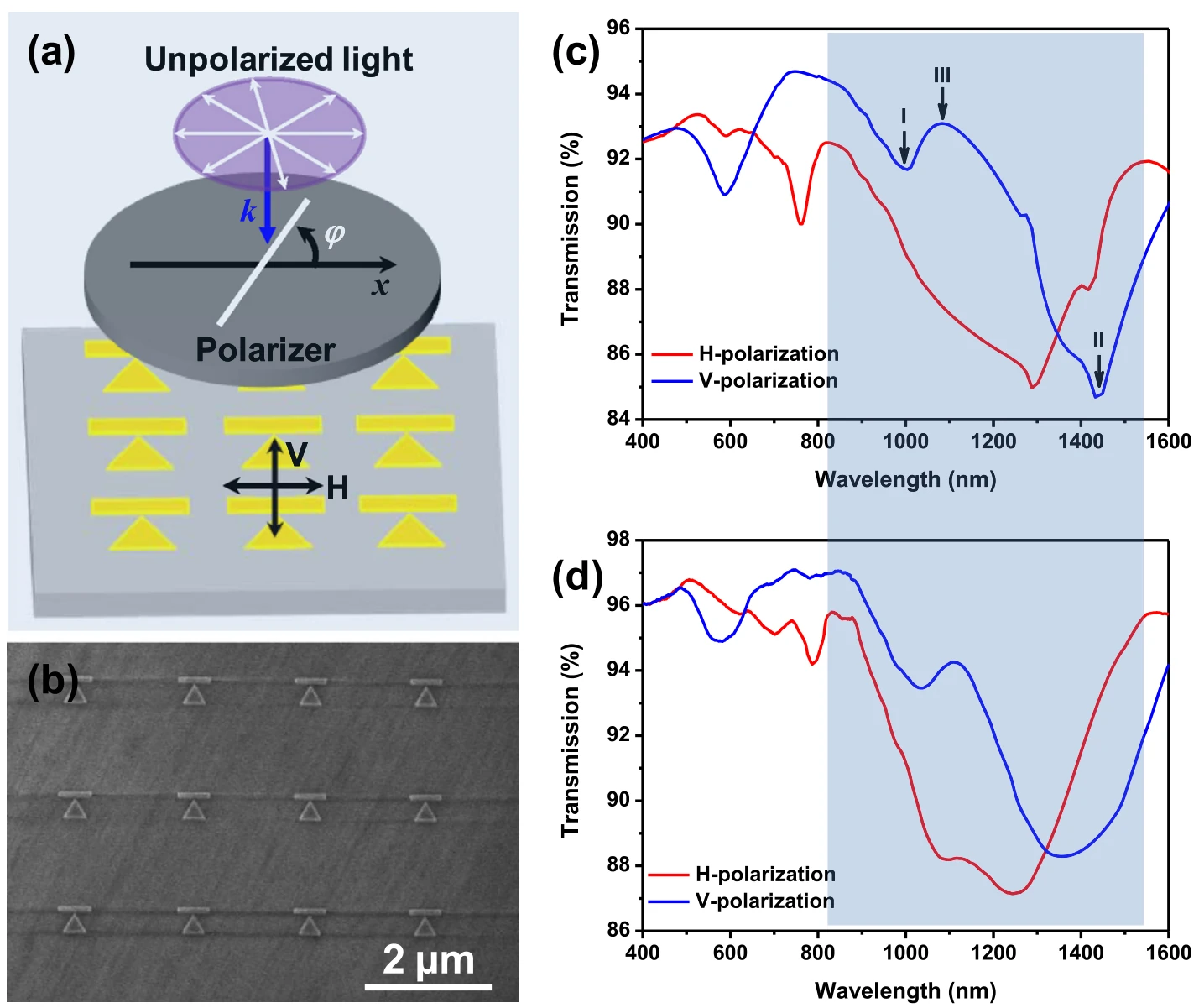
Each unit cell is a gold nanotriangle whose apex points at a gold nanorod. Light arrives at normal incidence, polarized either along the rod (H) or across it (V). Finite-difference time-domain (FDTD) simulations of the field and charge distributions identify which part of the cell is the bright resonator and which is the dark one, and fabricated arrays are measured with a microspectrophotometer.
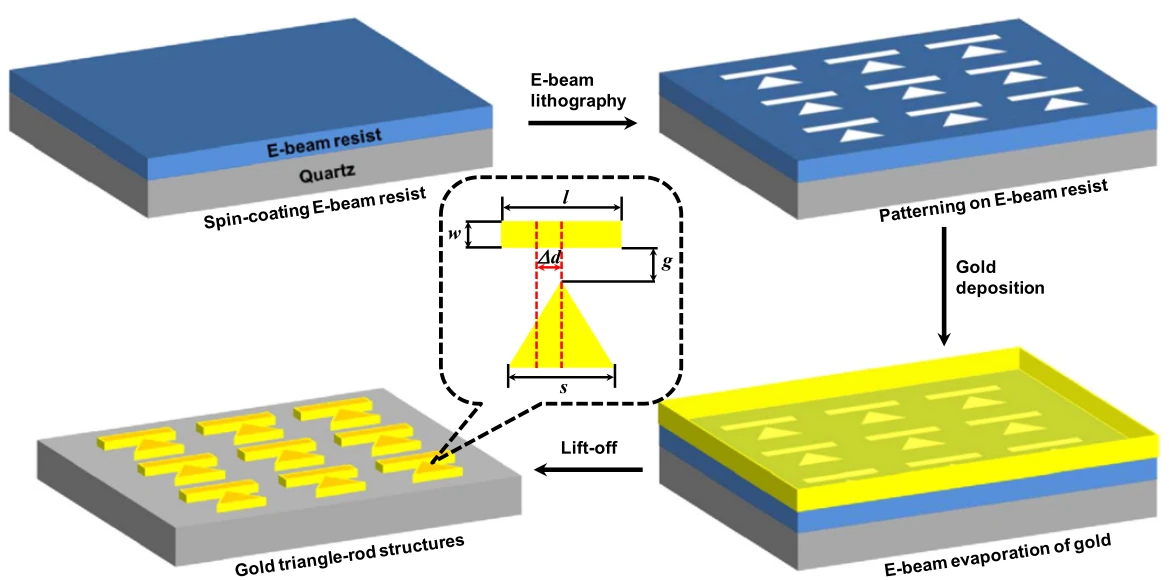
- The unit cell. An equilateral nanotriangle (side 400 nm) sits below a nanorod (550 nm long, 80 nm wide). Both are 50 nm of gold on quartz, arranged with a 2 µm period. The gap g between the apex and the rod and the sideways offset Δd are the parameters that are varied.
- The bright mode. Under V polarization the nanotriangle resonates as a dipole. Light polarized across the rod cannot directly excite the rod’s longitudinal plasmons.
- The dark mode. The localized surface plasmon at the triangle tip excites the rod through its near field. The rod responds with a multipolar mode (labelled j = 2) with three charge parts, and serves as the dark resonator.
- The transparency window. Destructive interference between the bright and dark modes raises a transmission peak (III) out of the broad valley. On either side, dip I is the in-phase (bonding) and dip II the out-of-phase (antibonding) coupling of the triangle’s dipole with the rod’s multipole. Under H polarization there is only one broad dipolar dip.
- Tuning by geometry. The gap g and the offset Δd set how strongly the two modes couple, so changing them reshapes or removes the window.
Results
The simulated and measured spectra of a sample with g = 20 nm and Δd = 0 nm agree well overall. The measured PIT peak is slightly red-shifted, which the authors attribute mainly to shape tolerance and to refractive-index differences between simulation and experiment.
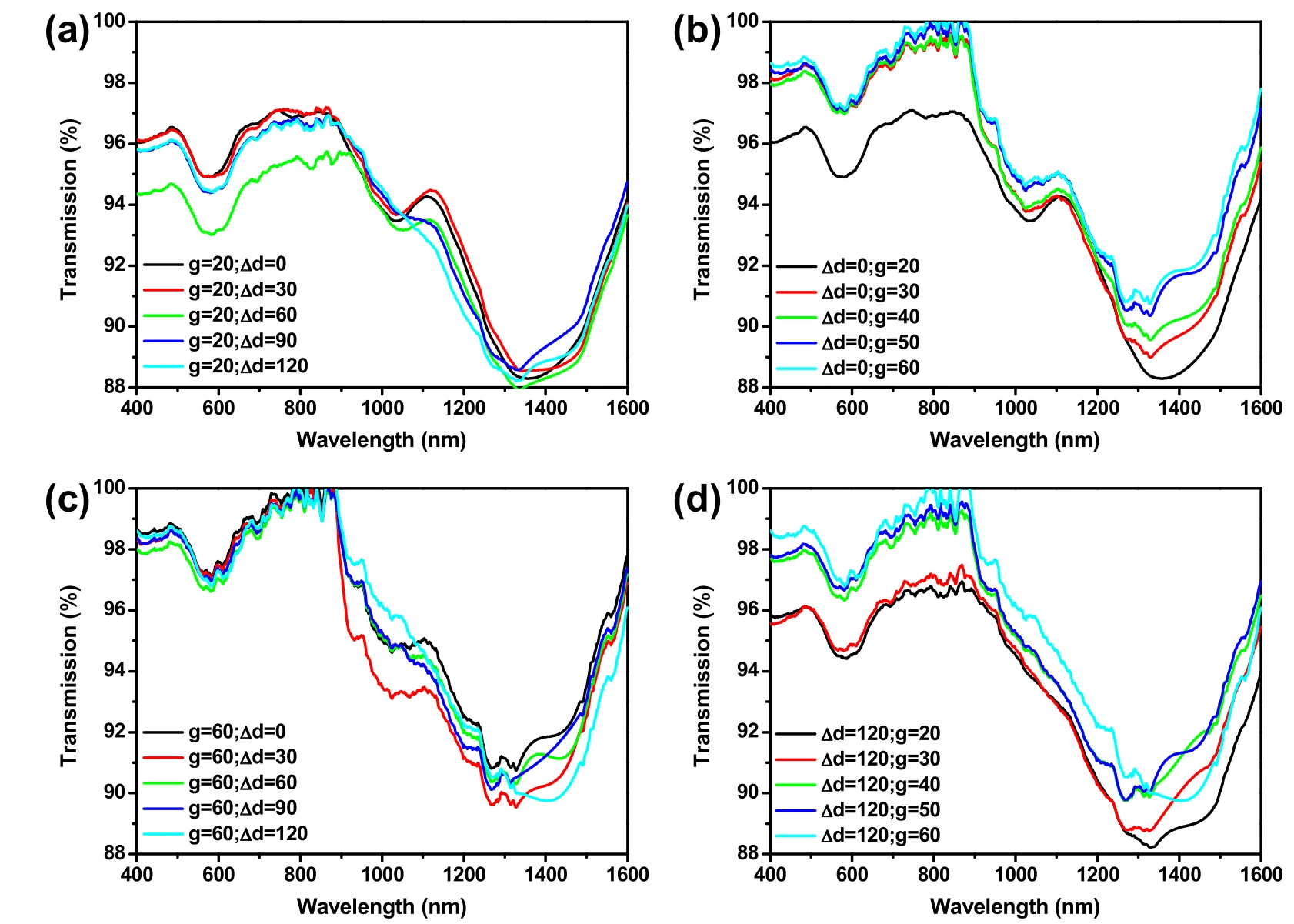
All arrays were measured under V polarization. Individual spectra vary slightly from array to array, possibly because of defects or inconsistency in the characterization system, but a general trend holds. At a fixed gap of 20 nm, the window gradually disappears as the offset grows. At a fixed offset, the transmission of the window gradually increases as the gap grows. Overall, at large gap or large offset the PIT effect becomes very weak, and at the largest offset of 120 nm it disappears whatever the gap: the coupling between triangle and rod is then too weak to excite the rod’s dark mode. Because small, controlled changes of g and Δd can mimic fabrication errors, the authors note that such variations should be considered when designing and evaluating PIT-based devices.
Cite
@article{si2015plasmon,
  title={Plasmon-induced transparency in coupled triangle-rod arrays},
  author={Si, Guang Yuan and Leong, Eunice Sok Ping and Pan, Wei and Chum, Chan Choy and Liu, Yan Jun},
  journal={Nanotechnology},
  volume={26},
  number={2},
  pages={025201},
  year={2015},
  publisher={IOP Publishing},
  doi={10.1088/0957-4484/26/2/025201}
}