3D Surface Matching Based on Adaptive Threshold and Curvature Map
In one sentenceFor single-view 3D scans of industrial workpieces: keep only the high-curvature points of the model via an adaptive threshold on its curvature map, then align it to the scene scan with descriptor-based coarse matching and ICP.
The problem
In industrial defect inspection and robotic sorting, a 3D scanner has a limited acquisition range, so each scan gives a single point cloud or depth map from one viewpoint, covering only part of the surface. Matching a workpiece model against such a scan is hard: feature points are sparse, there is a lot of redundant data, and the overlap is low.
The standard tools each have a weak spot, according to the authors. ICP (iterative closest point) aligns very accurately from a good starting pose, but is sensitive to initialisation and can get stuck in a local minimum when the geometry is incomplete or ambiguous. RANSAC-based methods struggle to separate adjacent or continuous surfaces. The integral volume descriptor (IVD) makes coarse matching more robust to noise, but its cost grows quickly on dense or noisy clouds. Learning-based registration, in turn, typically needs large annotated datasets and heavy computation, and generalises poorly across industrial scenes. This paper aims at a geometric method that keeps only the points that matter, so that IVD and ICP have less to process.
How it works
The method targets workpieces with pronounced curvature. It first shrinks the model point cloud to its high-curvature points, with a threshold that it finds by itself, and then matches in two stages: a coarse pose from IVD correspondences, and a fine pose from ICP.
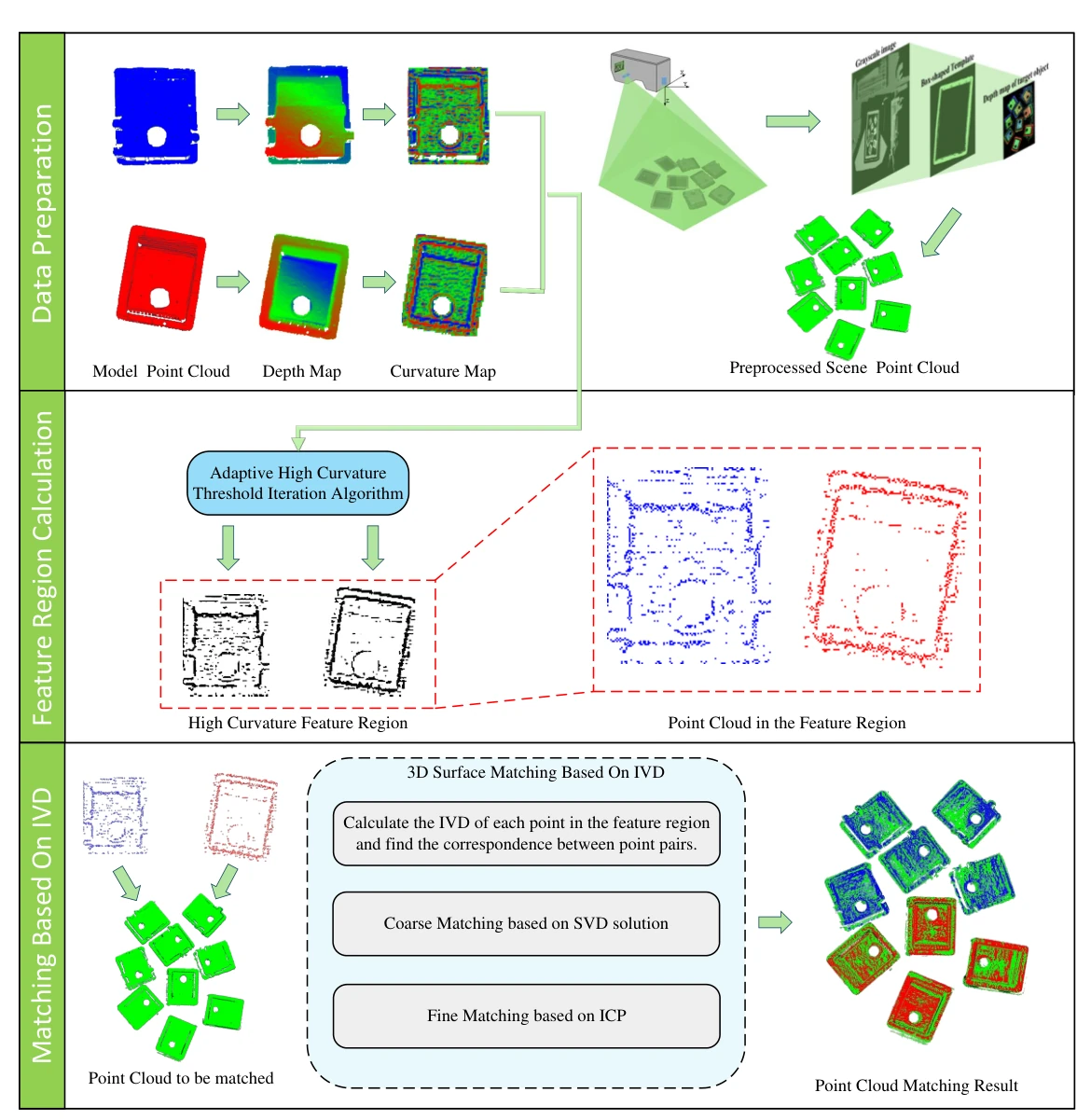
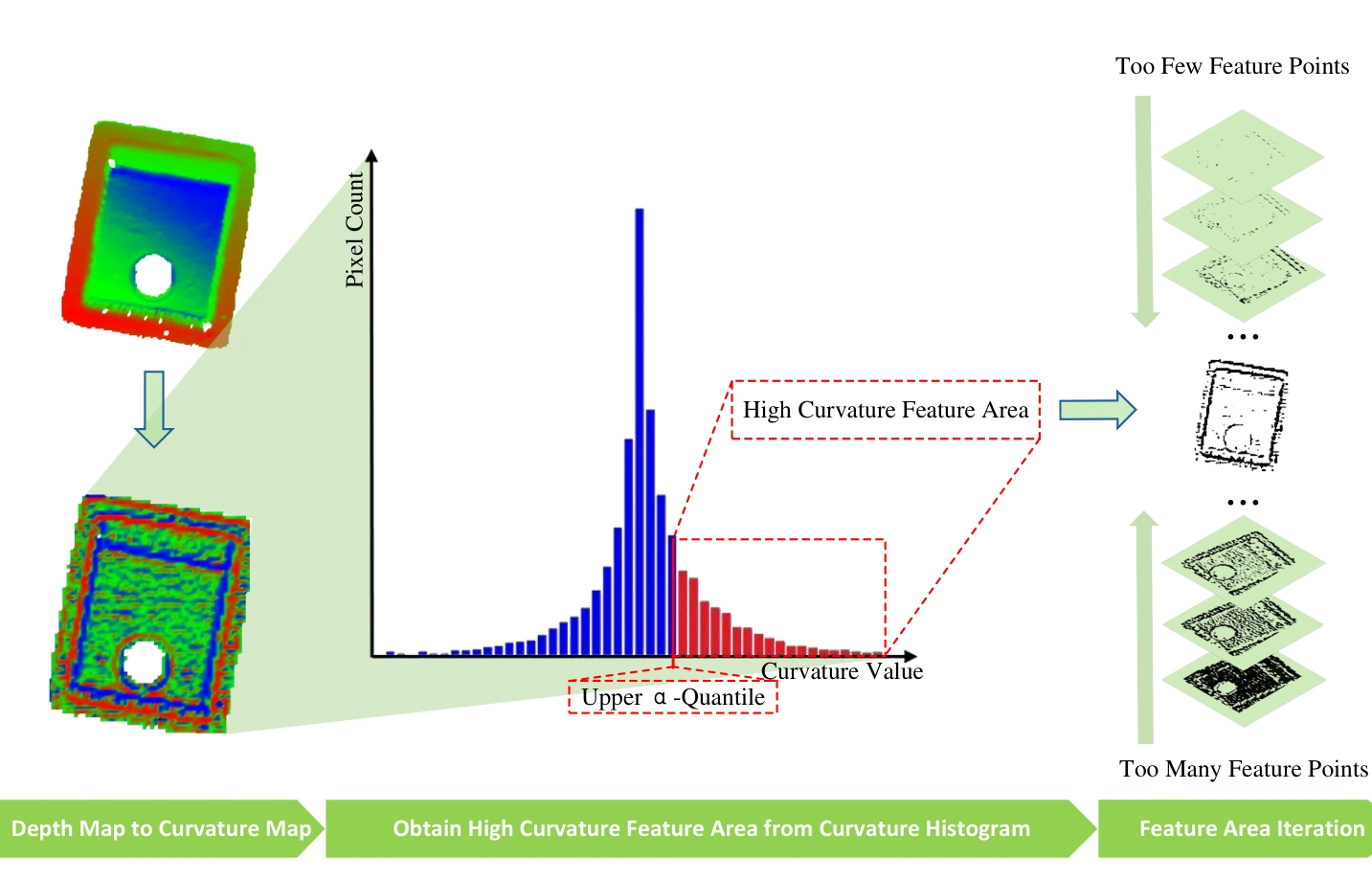
- Depth map and curvature map. The model point cloud is converted into a depth map. For each pixel, a quadratic surface is fitted to its neighbourhood, and the resulting average curvature becomes the pixel value of the surface curvature map.
- Adaptive threshold iteration. From the histogram of curvature values (bin width by Scott’s rule), the method fixes a target share of high-curvature points: the points above an upper percentile. The threshold is β = μ + Kσ, with the mean μ and standard deviation σ of the curvature map. If the share of points above the threshold is too large, K is increased by 1%; if too small, decreased by 1%. This repeats until the share lies within a tolerance of the target. The points above the final threshold are the model point cloud used for matching.
- IVD correspondences. The IVD of a point is the volume where a sphere around it overlaps the inside of the surface; it is computed by convolving a voxel occupancy grid with a spherical grid, which avoids the noise sensitivity of differential features. Model points and scene points with similar IVD and position give preliminary point pairs.
- Coarse pose by SVD. After removing the centroids of both point sets, the covariance matrix of the pairs is decomposed by SVD, giving the approximate pose of the target in the scene.
- Fine matching by ICP. The model is moved by the coarse pose, and ICP then minimises the squared distances to the scene points, stopping when the objective changes by less than a set value.
Results
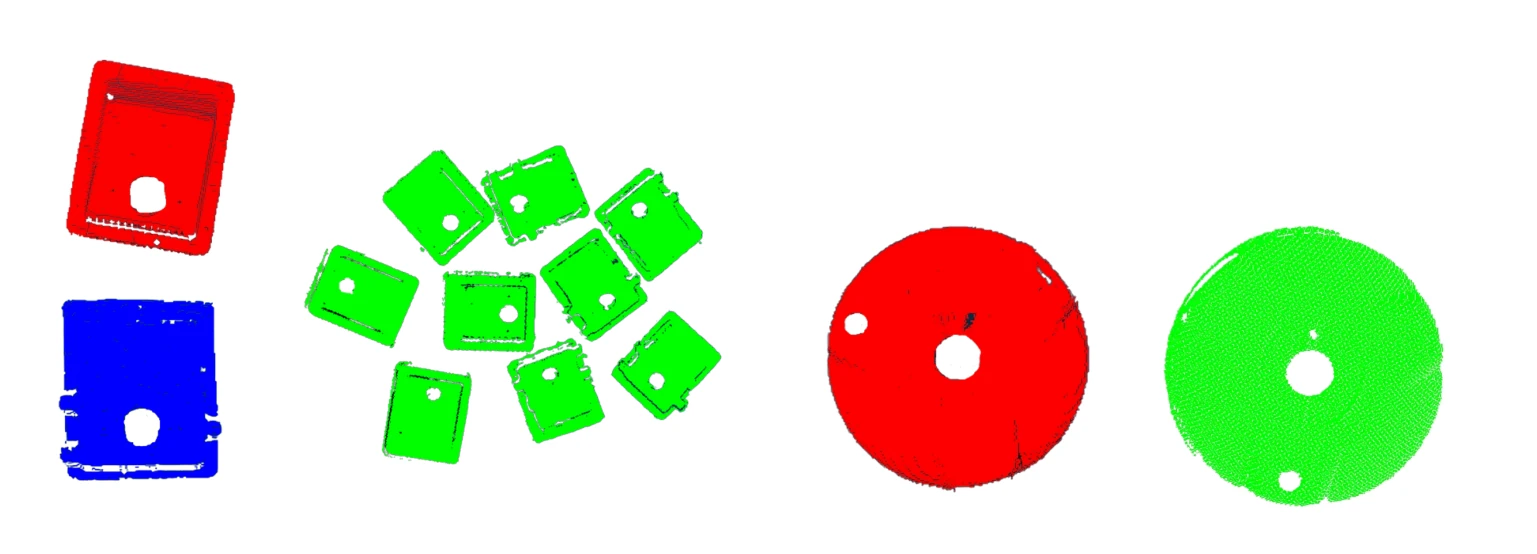
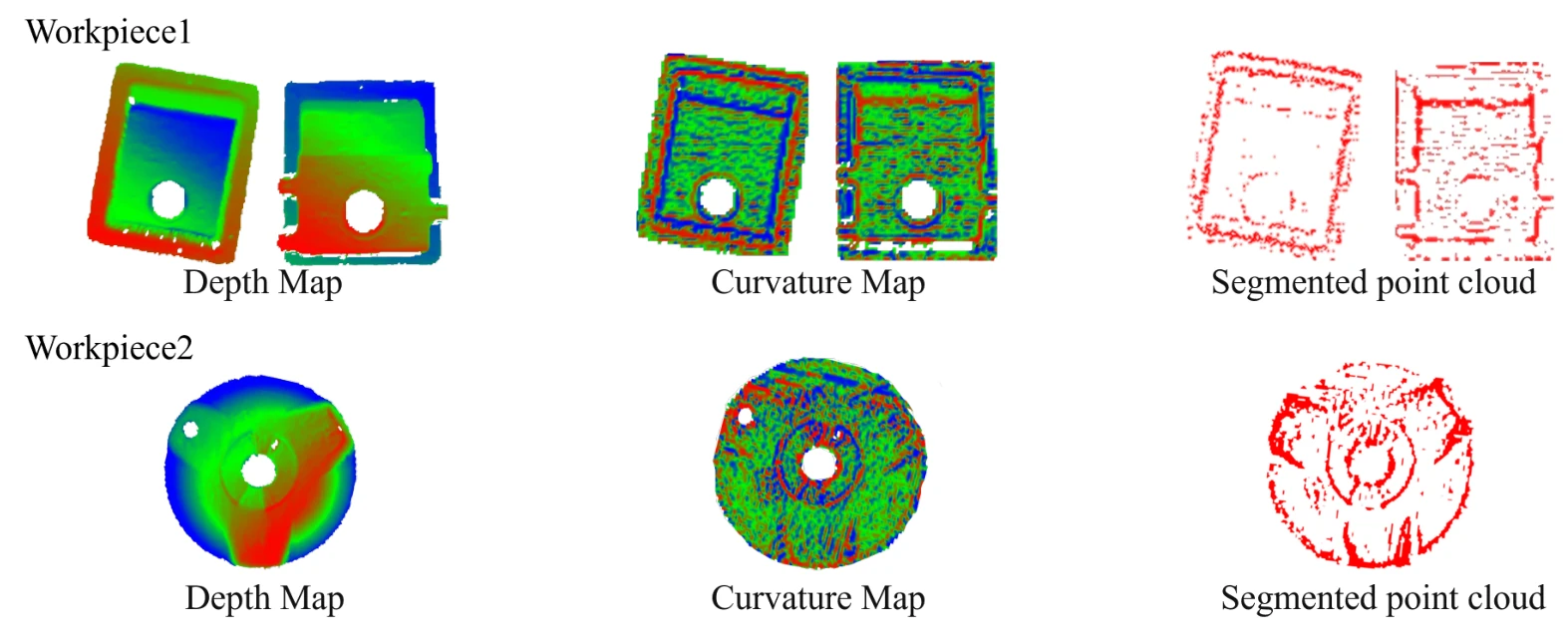
The experiments use point clouds from a structured-light camera of two workpieces (Fig. 4 of the paper). Workpiece 1 is matched with two models, front and back, in a scene of 149,469 points; Workpiece 2 uses one model (Table I). Accuracy is measured by RMSE between matched points, averaged over all targets when the scene holds several.
The segmentation takes the top 20% of curvature values as the target (80th percentile). The segmented clouds are much sparser than the originals, yet the edges and other geometrically significant points remain. Table II lists the converged parameters: the three models needed 502, 904 and 622 iterations and ended with 3,671, 3,369 and 4,860 feature points.
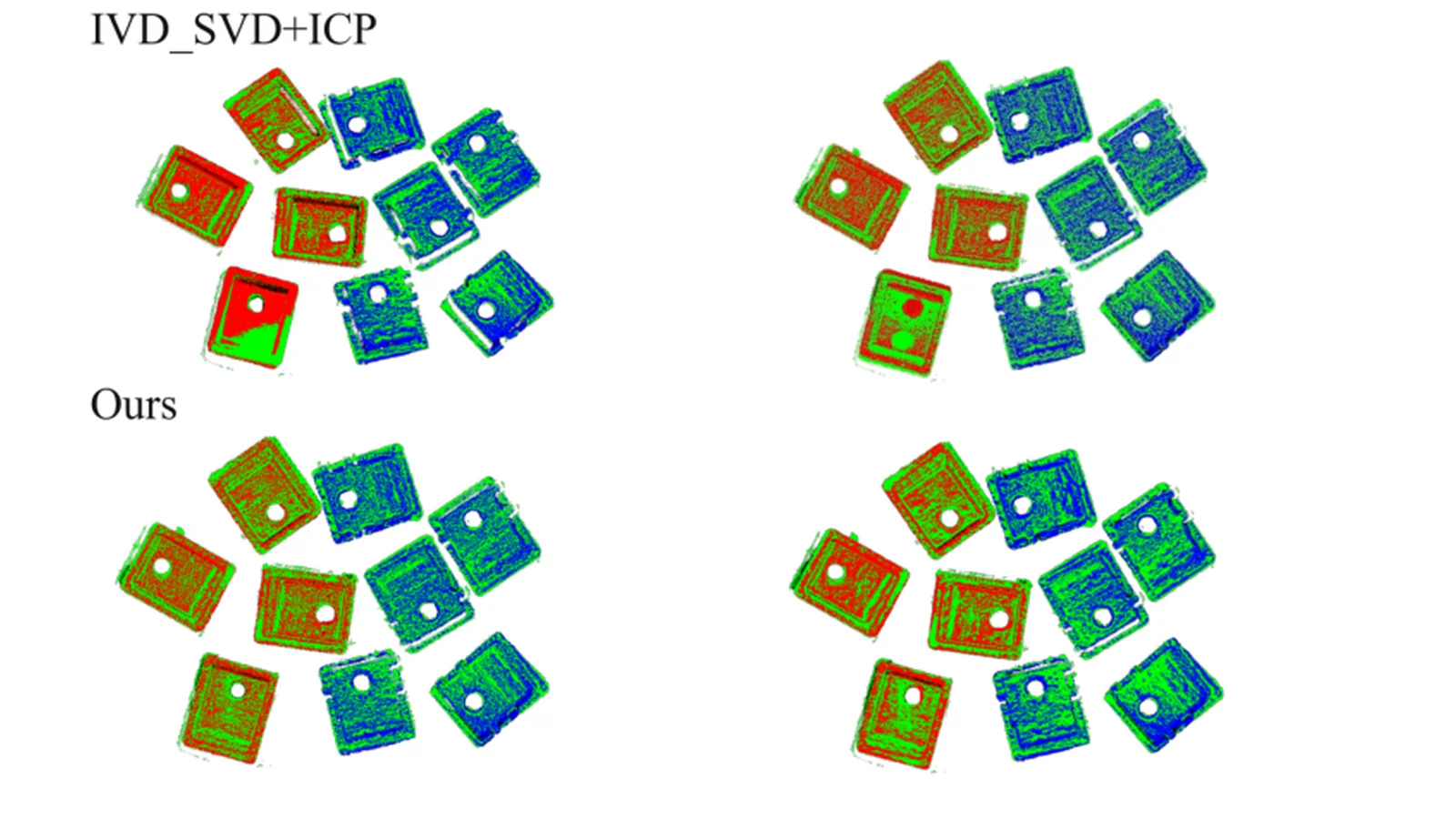
For matching, the paper compares IVD-SVD+ICP, the same pipeline with the threshold set by hand through three fixed K values (0.3, 0.6, 0.9), and the proposed method. The proposed method has the lowest RMSE on both workpieces. The margin is small on Workpiece 2, where K = 0.3 reaches 0.406 against 0.405. The fixed-K runs show how much the choice of K matters on Workpiece 1: RMSE ranged from 0.752 to 0.991, whereas the adaptive threshold needs no such tuning. Running time (Table III) is in the same range: 543 ms and 337 ms for the proposed method, against 532 ms and 489 ms for IVD-SVD+ICP, and some fixed-K variants were faster on Workpiece 2.
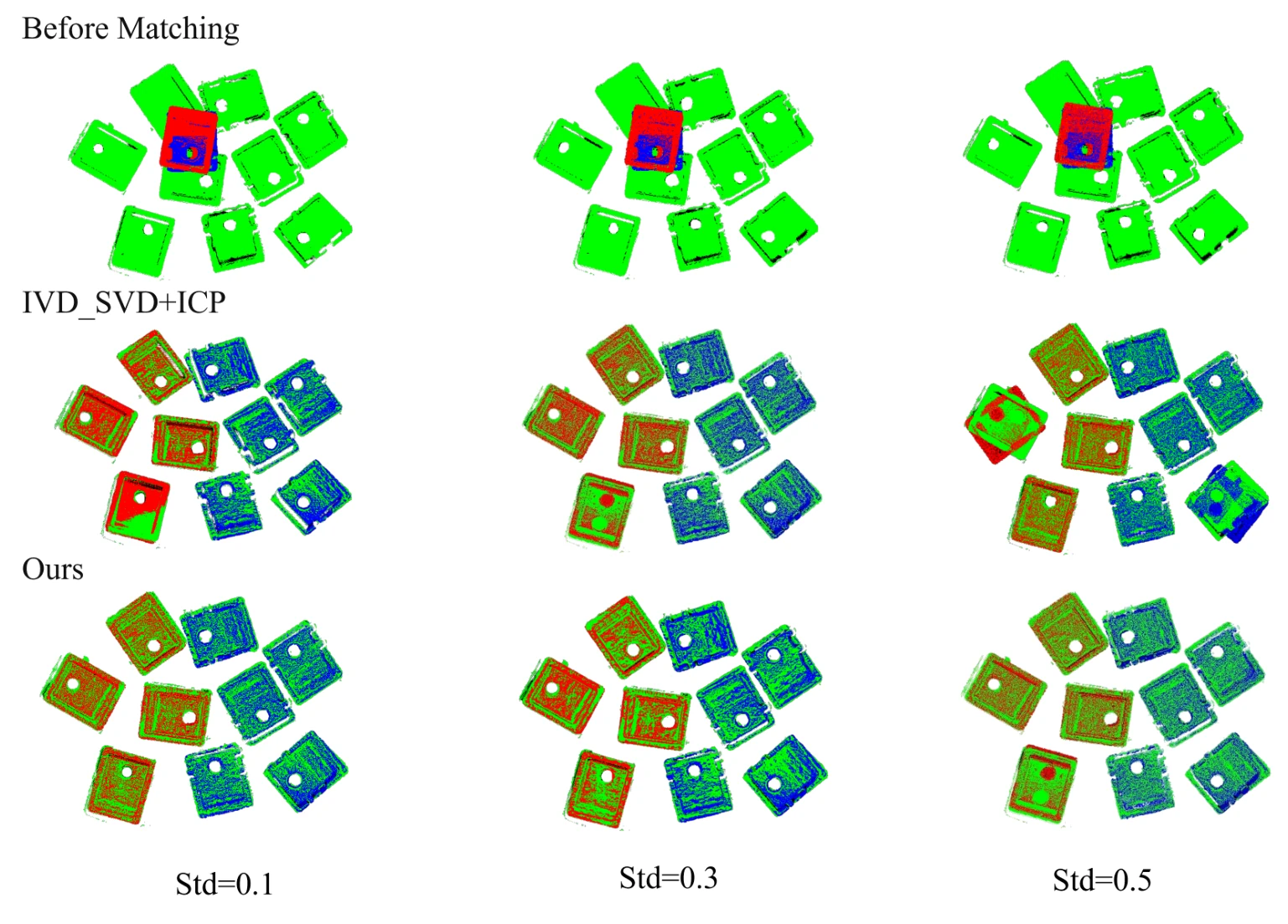
To test noise robustness, Gaussian noise with standard deviation 0.1, 0.3 and 0.5 was added to the point clouds, as low, medium and high noise, and the method was compared with IVD-SVD+ICP. The proposed method’s RMSE grows with noise but stays lower in all six cases: 0.748, 0.826 and 0.978 on Workpiece 1 (against 0.811, 1.01 and 1.121), and 0.417, 0.497 and 0.557 on Workpiece 2 (against 0.656, 0.667 and 0.728) (Tables IV and V). In low and medium noise, the matching shows no positional deviation. The authors state that the method still has limitations on high-noise point clouds, and name further work on feature extraction, more data for cross-scenario validation, and error analysis for heterogeneous point clouds.
Cite
@inproceedings{qiu20263d,
  title={3D Surface Matching Based on Adaptive Threshold and Curvature Map},
  author={Qiu, Jiajun and Cao, Ling and Zhang, Yunzhi and Chen, Lizhe and He, Siyuan and Pan, Wei},
  booktitle={2026 9th International Conference on Image and Graphics Processing (ICIGP)},
  pages={419--424},
  year={2026},
  organization={IEEE}
}