Gap measurement method based on projection lines and convex analysis of 3D point clouds
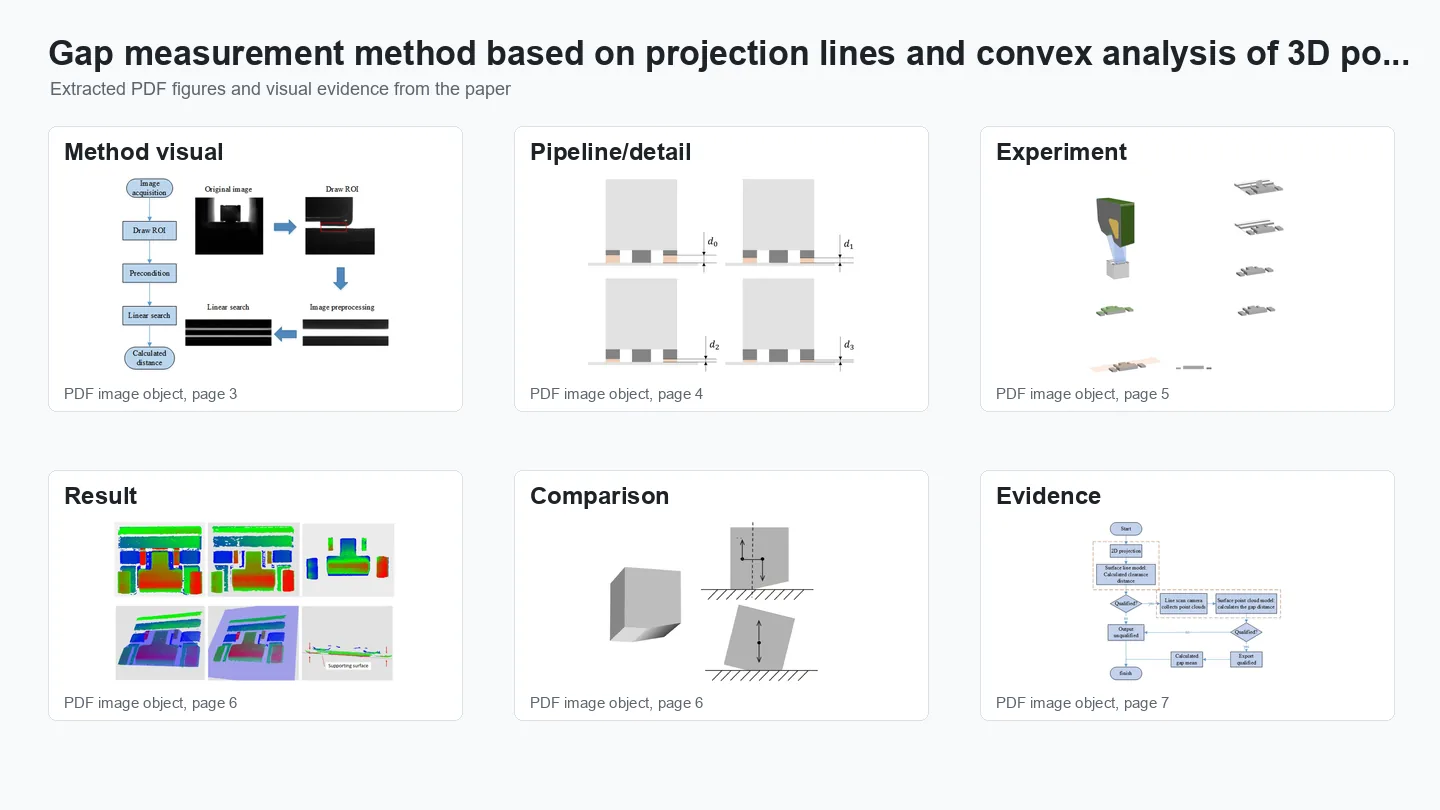
In one sentenceA relay’s gap to the ground (the base it stands on) must stay under 0.07 mm. A fast backlit 2D check screens every relay, then a 3D point-cloud model finds the surface the relay rests on and measures the gap to it.
The problem
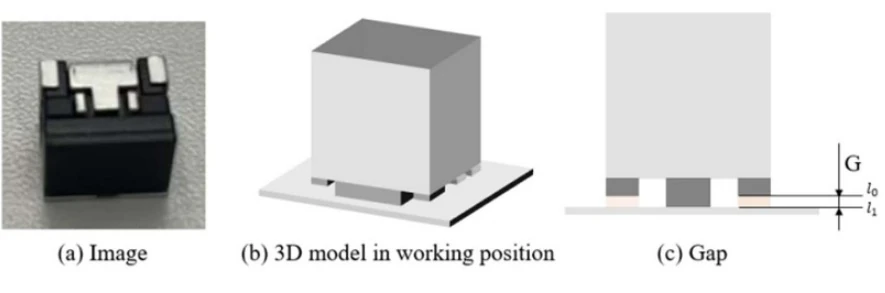
The gap between the lower surface of a relay and the ground (the base the relay stands on) is a critical factor in relay quality: it affects the relay’s conductivity and reliability, and for a qualified relay it must be less than 0.07 mm in the working state. Common displacement sensors each have drawbacks: eddy-current sensors must be customised to the measured part and are relatively costly, inductive sensors are disturbed by temperature, humidity and electromagnetic interference, capacitive sensors need a high-voltage supply and have large nonlinear error, and photoelectric sensors cope poorly with ambient light.
Optical measurement avoids contact, but each kind has a limit. Two earlier vision methods for measuring levitation gaps, Pixel Area and SelfConvNet, trade speed against accuracy: Pixel Area is fast but less accurate, SelfConvNet more accurate but slow. 2D methods also lose depth, including in occluded areas, which limits their accuracy. 3D point clouds keep that information, but their disorder and sparsity make the measurement time-consuming. On top of this, metal surfaces are prone to defects such as pits and burrs because of the limits of machining.
How it works
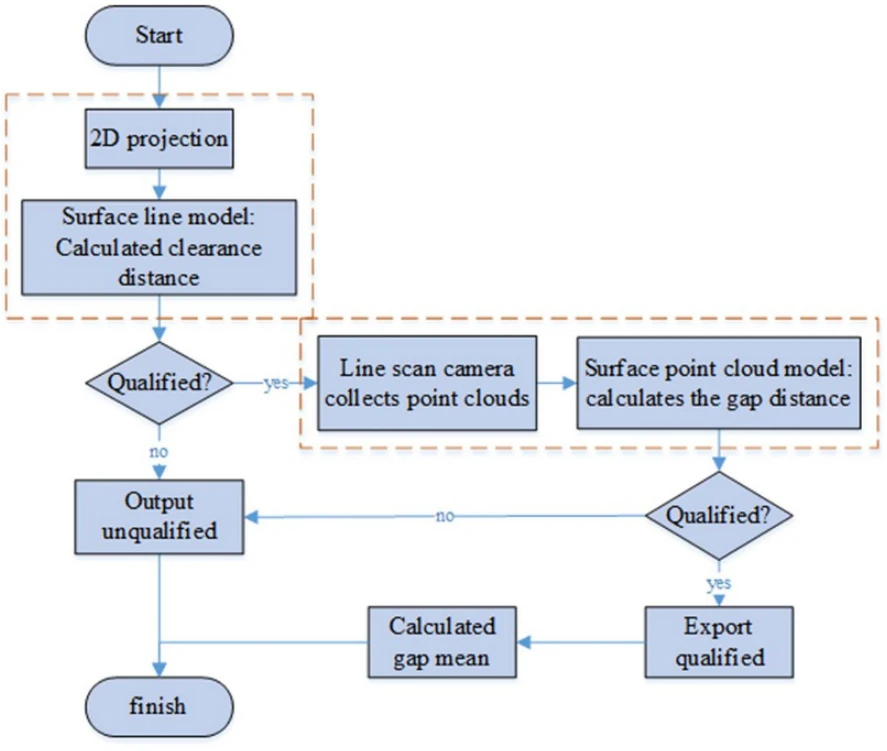
The method combines two measurement models. A 2D projection-line model measures the gap from a backlit image of it; a 3D surface point-cloud model locates the support surface between the relay and the ground and measures the gap against it. In inspection, the fast 2D model runs first and the 3D model checks the relays that pass.
- Backlit projection image. A highly directional backlight shines through the gap; it suppresses the diffraction of the illuminating light so that the edges image clearly. The camera sees the relay’s lower edge l0 and the base edge l1 as two clear straight lines with a bright gap between them.
- Projection lines. After guided filtering, which smooths noise while preserving edges, vertical search lines cross the region of interest, and on each line the two points with the largest Sobel gradient mark the edges. A line-deviation index discards points that differ from both neighbours by more than a threshold, which removes the noise points caused by burrs. Least-squares lines are fitted to the remaining points, and the pixel distance d between them is converted to millimetres with D = k·d, where the coefficient k is averaged over measurements of known gaps.
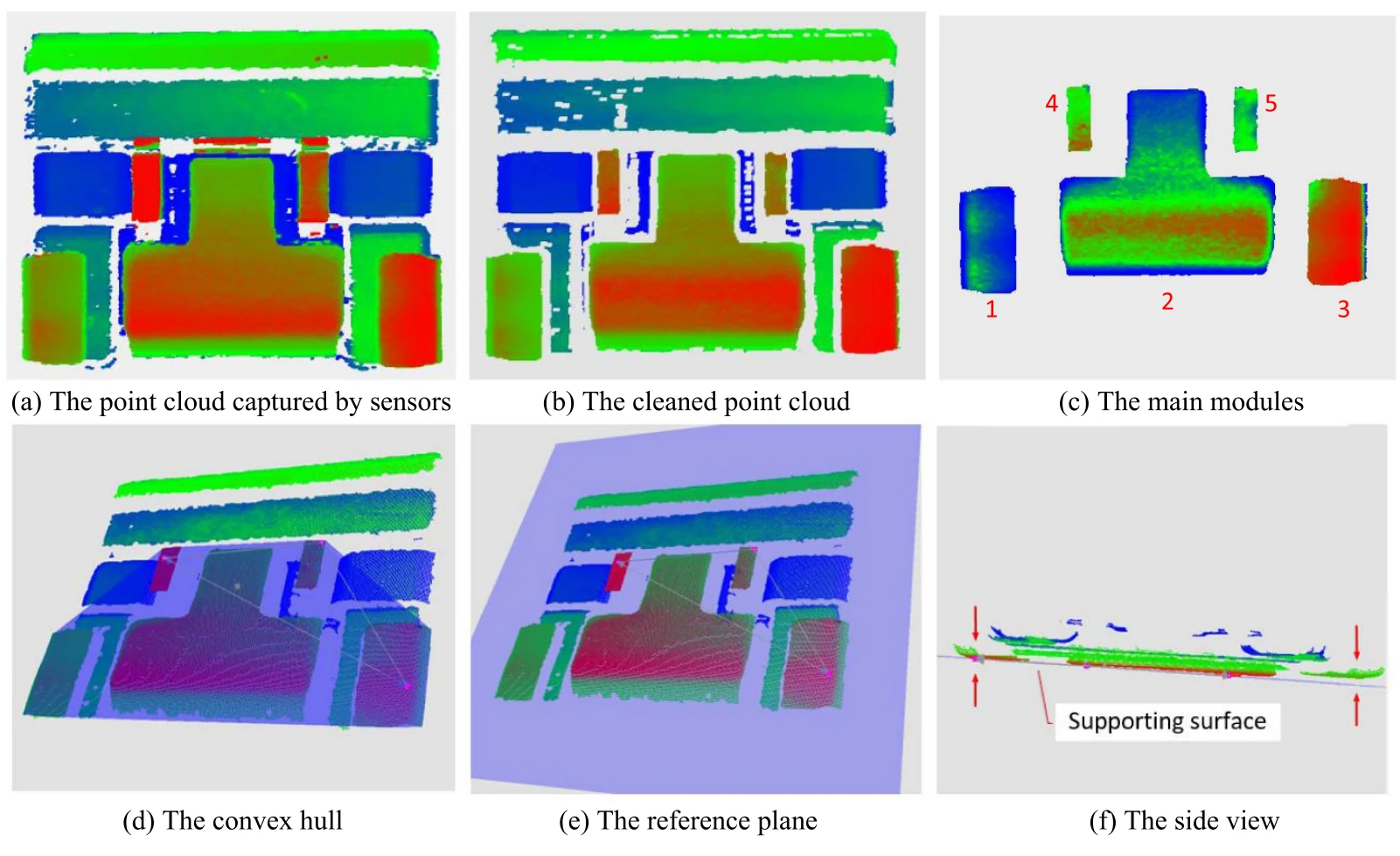
- Point-cloud clean-up. A line-laser profiler captures the relay’s lower surface as a 3D point cloud. A point is treated as an outlier when too many of its neighbours lie farther than a distance threshold. Connected-component segmentation then splits the surface into separate regions.
- Convex hull and centroid. Fitting a surface to the point cloud is complex, and its efficiency and accuracy are hard to guarantee together. Instead, the method builds the convex hull of the surface points with a fast convex-hull algorithm and computes the relay’s centroid, weighting each material part by its density. An object comes to rest when the resultant force and moment on it are zero, so the hull face that the centroid, projected along gravity, falls on is the support surface. The gap is the vertical distance from the points of the lower surface to this plane.
- Two-stage inspection. The projection-line model is the coarse stage and screens every relay. Relays that pass go to the point-cloud model, the fine stage, for a second measurement.
Results
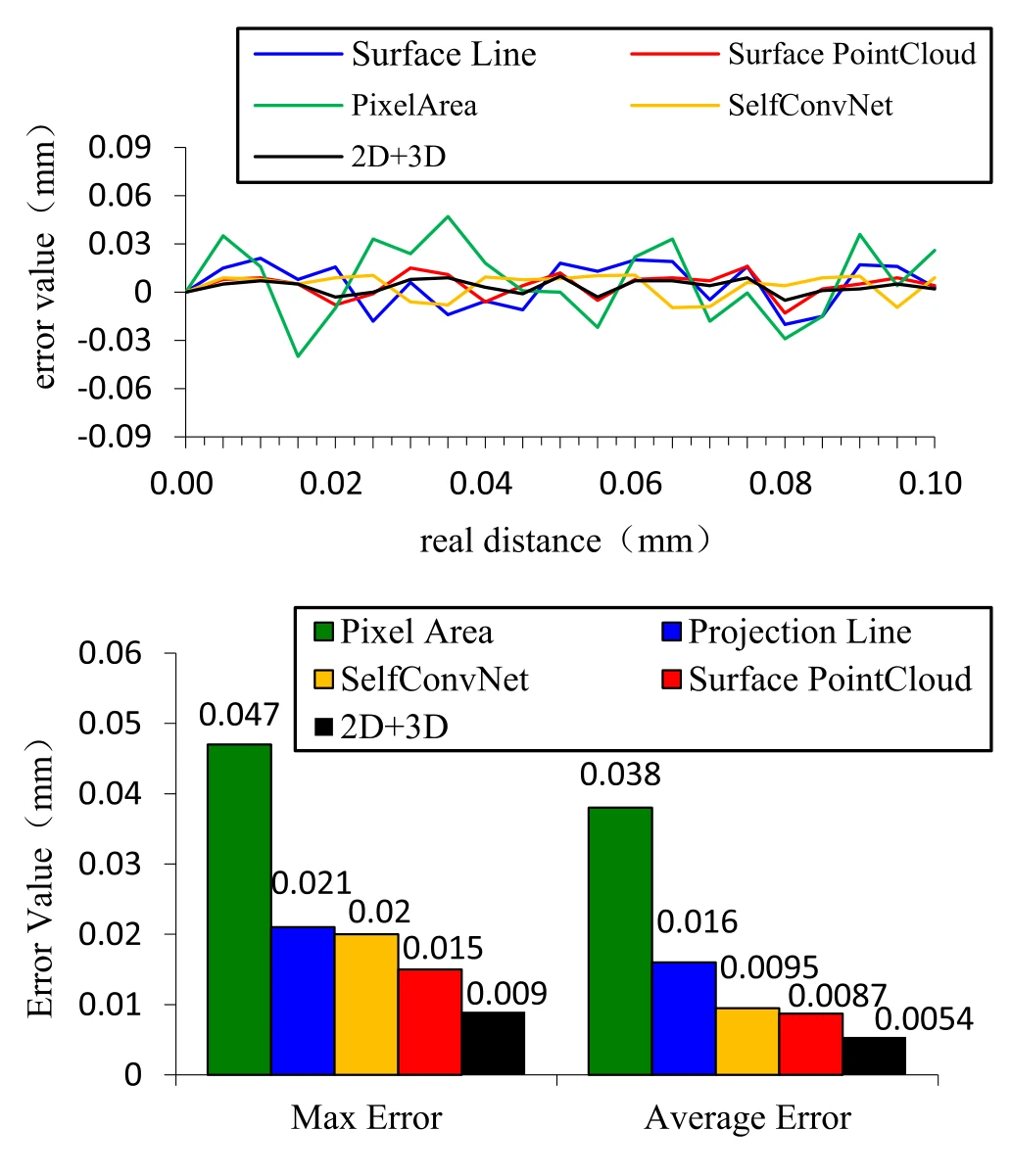
The experiments use a 4000 × 3000 camera with a highly directional backlight for the 2D images and an OPT-LPE50 3D laser profiler for the point clouds. The models are compared with Pixel Area and SelfConvNet. For accuracy, gaps from 0 to 0.1 mm at equal steps were set on a single relay. Pixel Area had the largest errors (maximum 0.047 mm, average 0.038 mm), followed by the projection-line model (0.021 and 0.016 mm), SelfConvNet (0.02 and 0.0095 mm) and the point-cloud model (0.015 and 0.0087 mm). In the linearity test, the point-cloud model followed the true gap more closely than Pixel Area and SelfConvNet, and the combined model was the most linear.
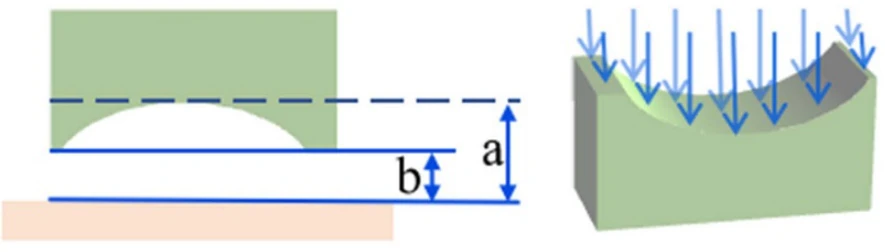
In the factory inspection test, 11,931 relays were measured, 9,247 good and 2,684 defective. The projection-line model was both more accurate and faster than Pixel Area (6.6%, 48.5 ms), and the point-cloud model beat SelfConvNet (2.6%, 510 ms) on both counts. The combined model had the lowest false-drop rate (the share of relays misjudged) and was faster than both the point-cloud model and SelfConvNet, meeting the requirements of real-time on-site inspection. Manual inspection of mis-detected relays showed surface defects of varying degree, particularly pits and burrs. At a pit, edge occlusion makes the projection image show the lower surface at line b rather than at the pit bottom, line a, so Pixel Area, SelfConvNet and the projection-line model, which all work from projection images, lose accuracy there. The point-cloud model measures the distance between the entire surface and the support surface, which makes it less susceptible to pits. The authors sum up the trade-off: 2D methods are simple and fast but limited by the missing dimension and more prone to errors from surface defects, while 3D methods are more accurate and reliable at the cost of longer processing time.
Cite
@article{pan2024gap,
  title={Gap measurement method based on projection lines and convex analysis of 3D points cloud},
  author={Pan, Wei and Jiang, Bin-feng and Tang, Wen-ming and Wu, Fu-pei and Li, Sheng-ping},
  journal={Measurement Science and Technology},
  volume={35},
  number={10},
  pages={105024},
  year={2024},
  publisher={IOP Publishing},
  doi={10.1088/1361-6501/ad63c3}
}