Sequencing in Transformation of Rasterized 3D Models
In one sentenceThis thesis turns reshaping a structure of voxels, LEGO bricks or chained cubes into a sequence of moves a machine can follow, keeping the total work low while respecting how parts can be picked, placed and folded.
The problem
A rasterized 3D structure is built from discrete, equal-sized parts, the way a picture is built from pixels: voxels in a computer, and cubes, bricks or food cans in the physical world. Such parts are easy to process as data, easy to reuse and suited to mass production. The thesis asks how to change one such structure into another. It frames this as a transformation from a source structure to a destination structure, and looks for an efficient sequence of operations that a machine can follow, with efficiency measured by an application-dependent cost function. Building a structure from a material palette is a special case, in which the source is the palette.
The difficulty is that the problem is discrete. Even deciding which part goes where is a combinatorial problem: for n parts there are n! possible assignments. The lowest-cost assignment is not necessarily executable either. A suction gripper can only pick parts on the top surface, a LEGO brick cannot be picked while other bricks cover or surround it, and a brick cannot be placed where it would hang in the air. Sequencing therefore has to trade the total amount of work against physical feasibility, and for bricks also against how many of the source parts are reused.
How it works
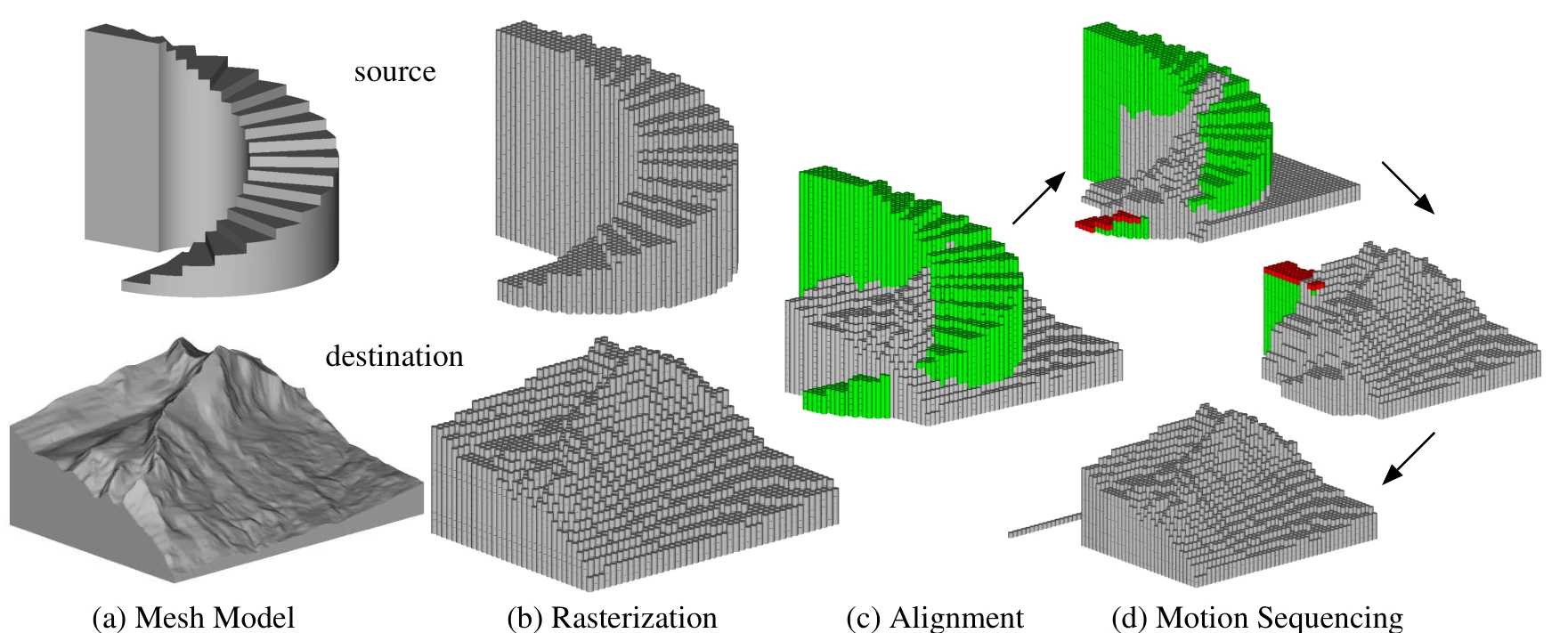
The thesis studies three cases that, in its words, represent the majority of sequencing problems for transforming and shaping rasterized structures: pick-and-place of homogeneous voxels (Chapter 3), pick-and-place of heterogeneous LEGO bricks (Chapter 4), and folding of voxel chains (Chapter 5). The explainer follows the thesis’s worked voxel example step by step, then places the other two cases alongside it.
Align and classify. Both mesh models are rasterized into voxels. Assuming they are already aligned vertically and only translation is allowed, an exhaustive search in the horizontal plane finds the alignment with the largest overlap. Voxels present only in the source are movers (M), voxels present only in the destination are voids (V), and overlapped voxels stay where they are. If the numbers of M and V differ, the extra voxels go to, or come from, a linear stack.
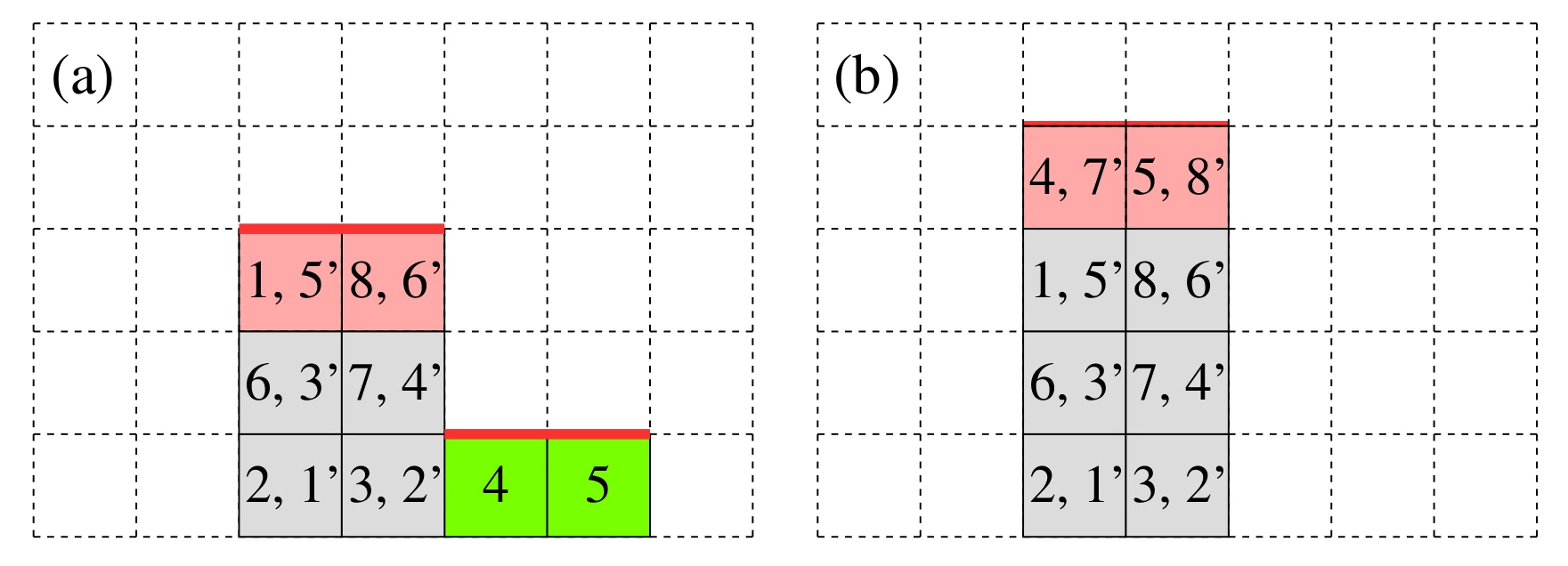
Price every move. The cost function models a three-axis Cartesian machine that moves sideways only at a clearance plane zmax: the cost cij of moving mover i into void j is cij = |xj − xi| + |yj − yi| + 2zmax − zi − zj. Pairing every M with a V at minimum total cost is an assignment problem, which the Hungarian method solves in O(n3) time instead of comparing n! options.
Respect top access. With a vacuum suction gripper, only voxels on the top surface can be picked or placed. Pairing all M and V at once (the global optimisation strategy, GOS) gives a lower bound on the cost, but the pairs may deadlock. The local optimisation strategy (LOS) builds the cost matrix only from the M and V that are currently accessible, applies the Hungarian method, and moves those pairs.
Update and repeat. After each round the top surfaces change, a new cost matrix is built, and the process repeats until every M has been placed. In the worked example LOS reaches a total cost of 27, the same as the GOS lower bound. Two simpler baselines are also compared: a greedy strategy (GSS) that moves only the single cheapest accessible pair at each step, and a random one (RSS).
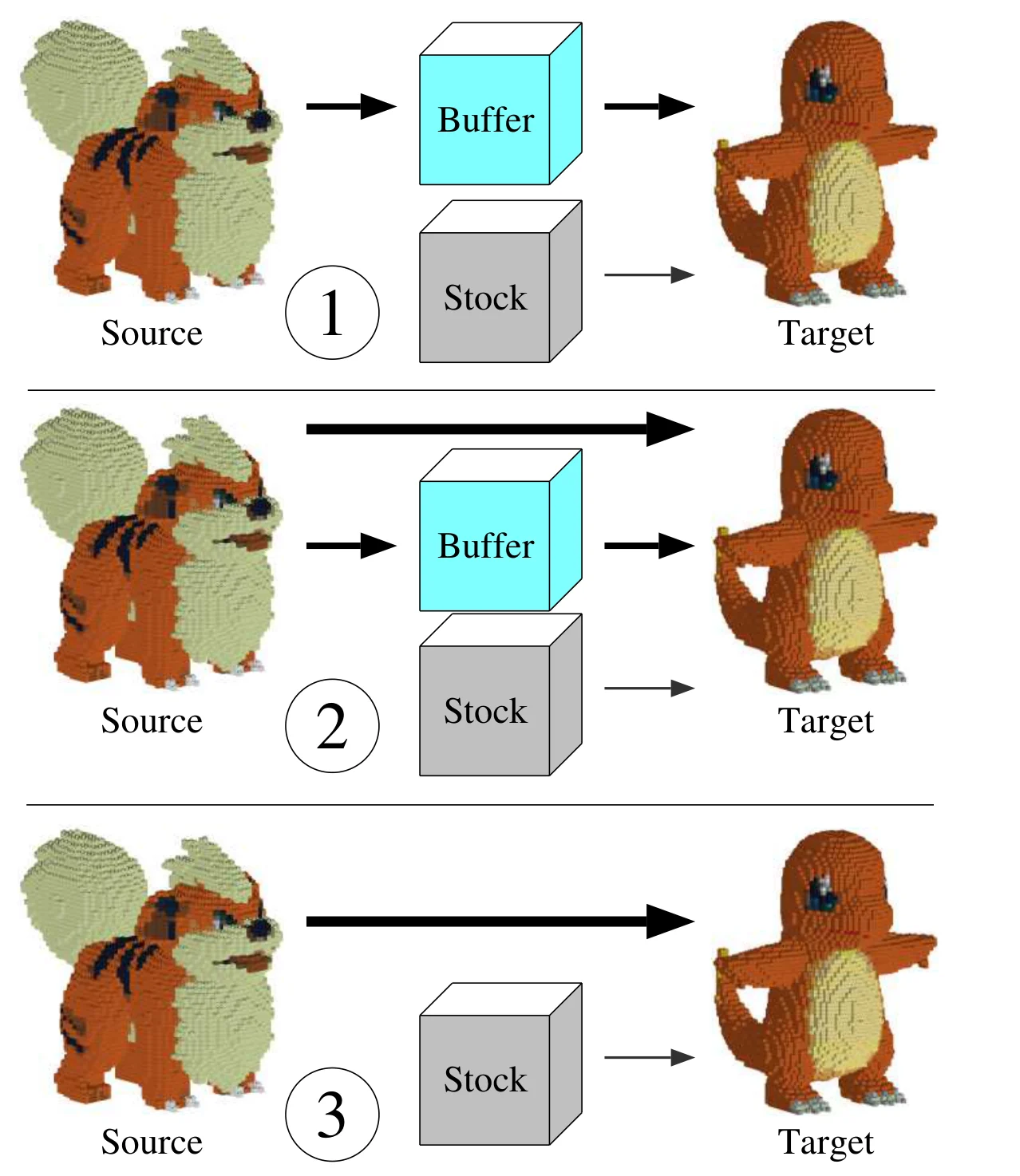
Extend to bricks and chains. Bricks (LEGO). Voxels are merged into bricks layer by layer. The rigid approach (RT) generates both brick layouts before transformation, and the flexible approach (FT) generates the target layout on the fly, preferring brick types that are movable on the source. Each approach is combined with three strategies for routing bricks through a buffer and a stock (see the figure below), giving six algorithms, RT1–RT3 and FT1–FT3, named after the approach and the strategy number.
The algorithms are scored by cost (the number of pick-and-place actions), reuse rate (the share of source bricks that end up in the target) and an overall performance that grows with reuse and falls with cost.
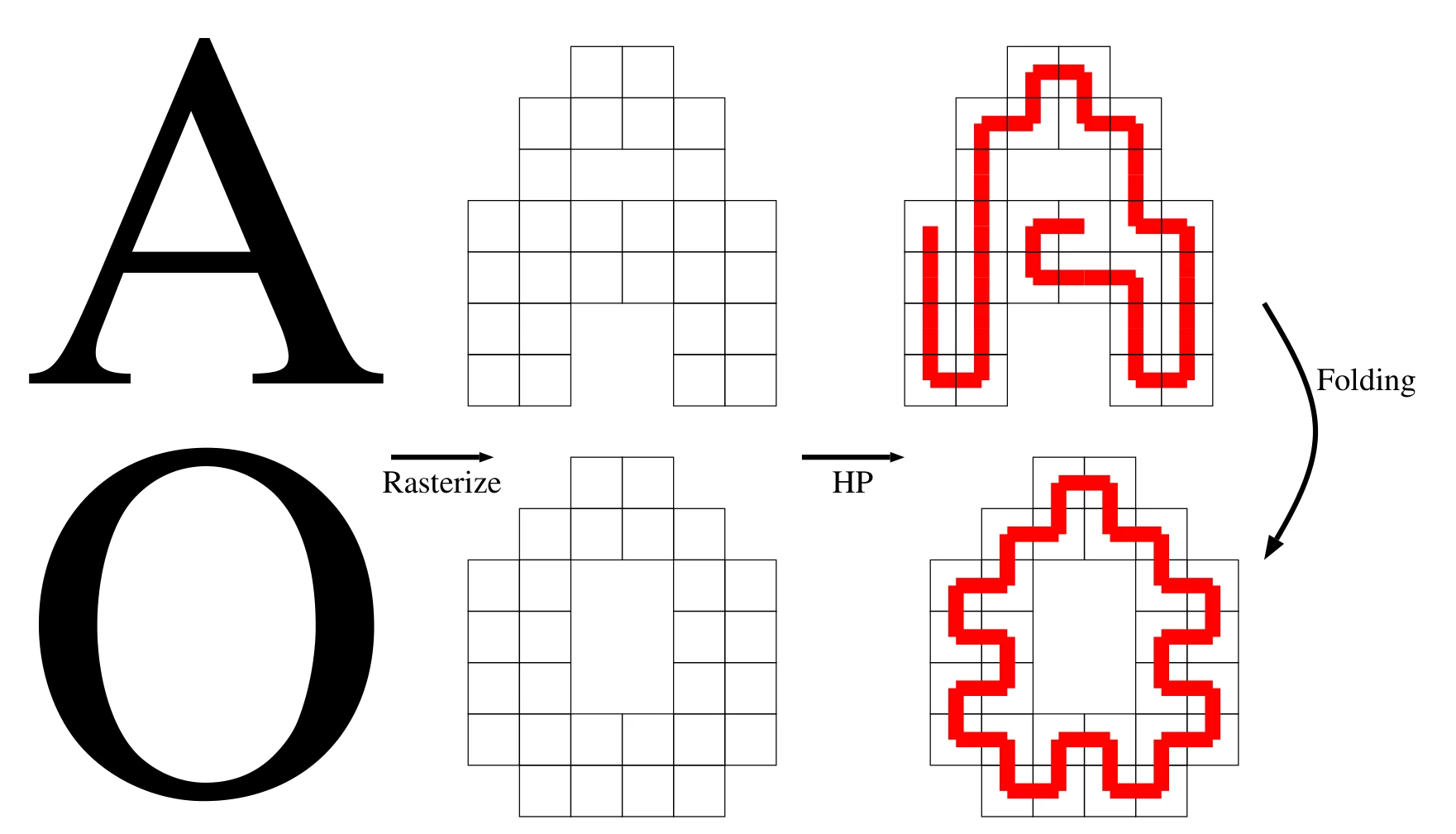
Chains. A shape is turned into a 1D string by finding a Hamiltonian path through its voxels. The path is made possible either by pruning and appending voxels or by dividing each voxel into 4 (2D) or 8 (3D) sub-voxels. The fold is then planned from the difference between the start and target joint angles.
Results
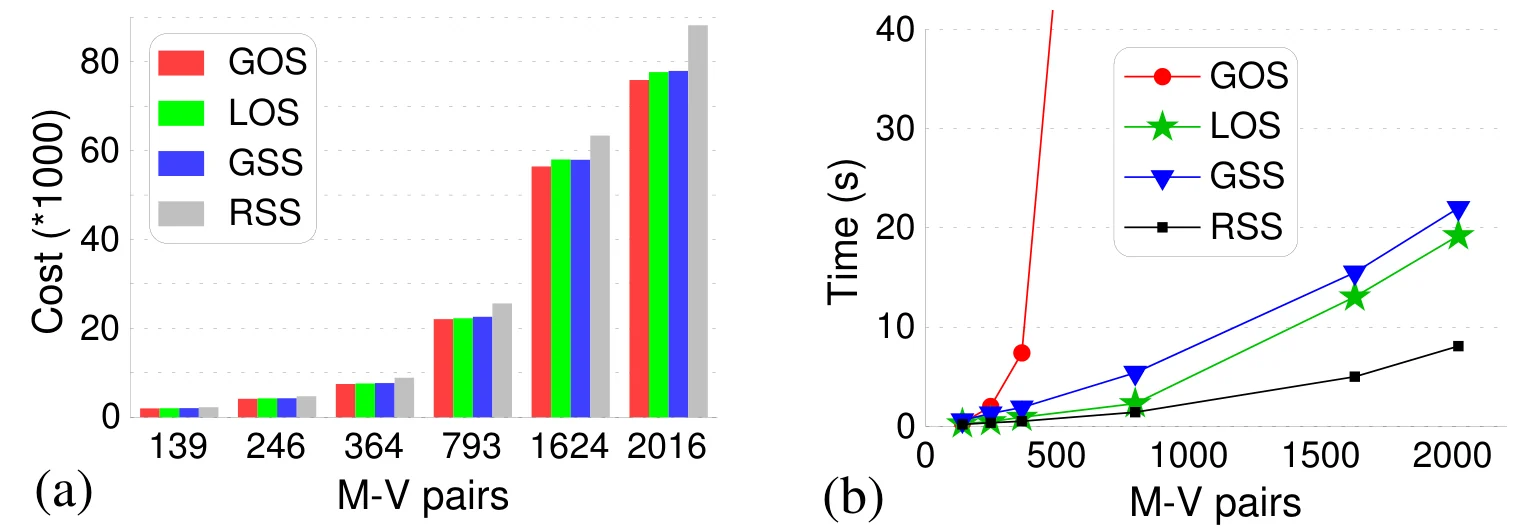
The voxel strategies were tested on eight models (wall, pyramid, starfish, cube, igloo, castle, stairs and the Eiger mountain), each rasterized to between 2,250 and 2,550 voxels and transformed into every other. GOS always gives the lowest cost but does not by itself define a feasible sequence, and it is the slowest, because it runs the Hungarian method once on a very large cost matrix. LOS is second in cost, GSS slightly worse, and RSS clearly worse but fastest. The work is set by the number of M-V pairs, not by model size: wall → pyramid needs 1,643 pairs, while the more similar pyramid → igloo needs only 325. Across rasterization resolutions, the total cost grows about linearly with the number of pairs, and so does the time of LOS, even though the Hungarian method itself is O(n3). LOS stands out for the balance it strikes between cost and computation time. Its stated limitation is the top-access constraint, which rules out overhanging structures. Bricks that lock together, like LEGO, can form overhangs, which motivates the LEGO chapter.
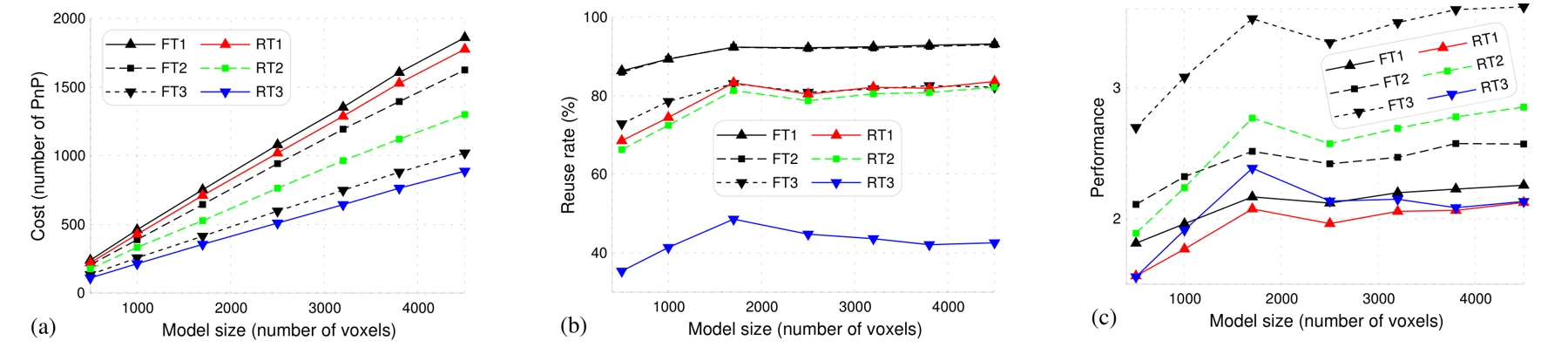
For LEGO, eight triangle-mesh models were converted to brick models. In the average over all pairwise transformations, cost rises linearly with model size, and Strategies 1, 2 and 3 cost successively less. Strategies 1 and 2 reach very similar reuse rates, so the thesis concludes that disassembling the whole source up front is not worthwhile. FT reuses more bricks than RT, but its bricks tend to be smaller than the best fit, which gives weaker structures with internal sliding planes and more bricks in the target. FT3 reaches a reuse rate comparable to the best RT algorithms, and in the transformations from one model to the other seven it matches the reuse of FT1 and FT2 at a much lower cost. With colour information (114 colours, and exterior bricks must match in colour as well as shape), reuse falls but does not drop to zero, because interior bricks may take any colour. The thesis notes that the overall-performance metric is empirical, and that the relative ranking may change in scenarios that define cost differently.
Two directions are left as future work: adding force analysis such as finite element analysis, so that intermediate structures as well as the final one are stable, and transforming at the level of modules (groups of parts moved as a whole) rather than single parts, which the thesis expects to improve both reuse rate and cost.
Cite
@phdthesis{pan2018sequencing,
  title={Sequencing in Transformation of Rasterized 3D Models},
  author={Pan, Wei},
  year={2018},
  school={Singapore University of Technology and Design}
}