Towards uniform point distribution in feature-preserving point cloud filtering
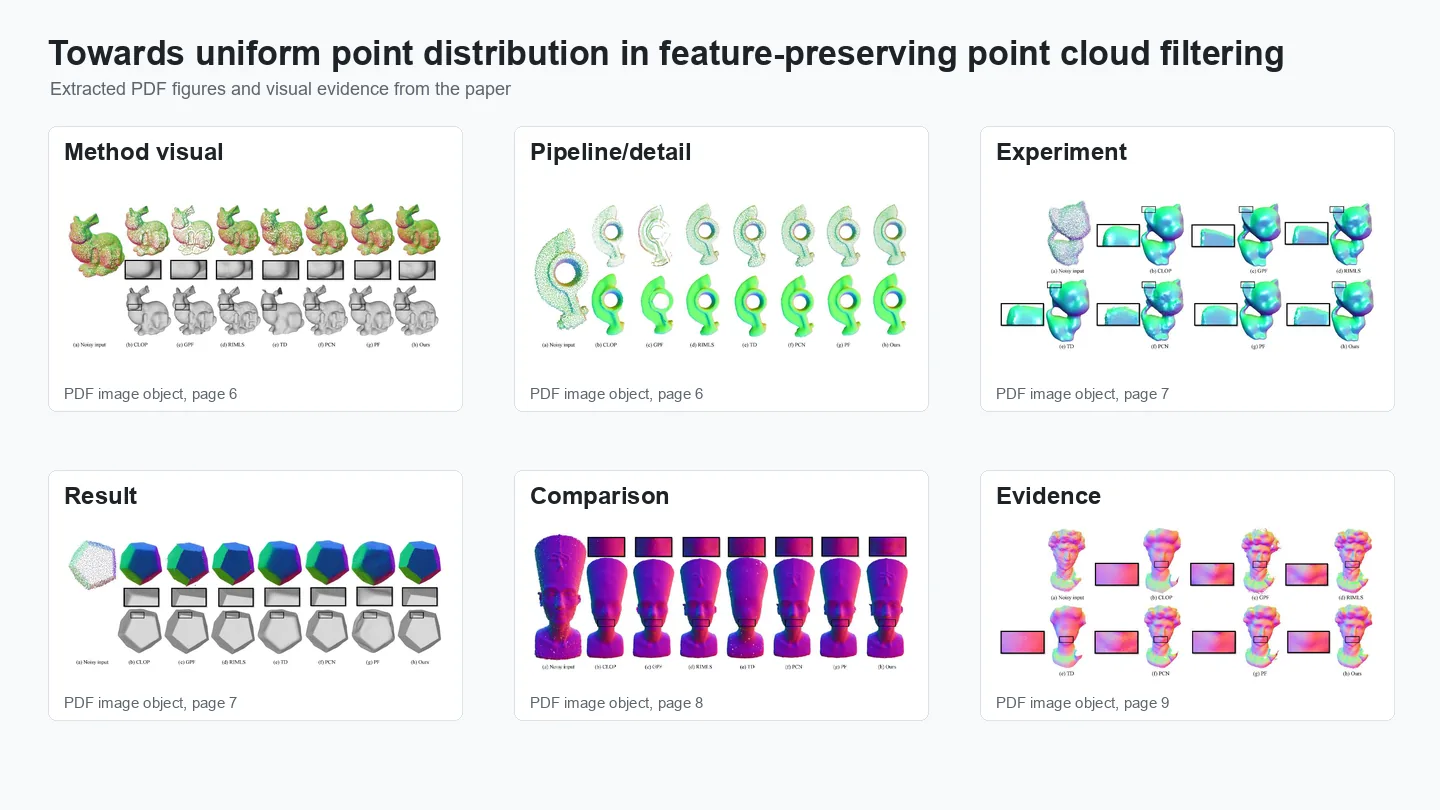
In one sentenceA point cloud filter that pairs an edge-aware data term with a repulsion term, removing noise and keeping sharp edges while the filtered points stay evenly spread instead of leaving gaps near edges.
The problem
Raw point clouds from scanners contain noise, so they are usually filtered before upsampling, surface reconstruction or other downstream use. A good filter should move the noisy points back onto the underlying surface, keep sharp edges and corners, and leave the points evenly spread. Existing methods tend to manage only part of this. Position-based methods such as CLOP smooth well but, since they ignore normals, tend to smear sharp features. Normal-based methods keep sharp edges better, but their filtered points are often unevenly distributed, and some that include a repulsion term still leave gaps near the edges. Deep learning methods need noisy training data with ground truth and work on local patches; they too give uneven distributions, even with a repulsion loss, and sparse or unevenly sampled inputs are hard for them.
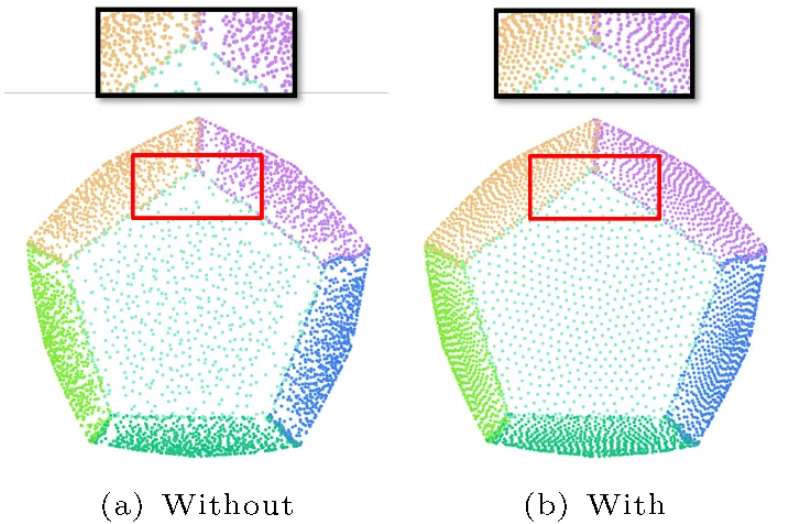
The paper builds on the edge-aware point update of an earlier low-rank filtering method. On its own, that update moves points towards sharp edges, where they concentrate and leave gaps beside the edge. These gaps hurt downstream steps such as upsampling and surface reconstruction.
How it works
The method has two phases. It first smooths the point normals, then updates the point positions using those normals. The position update minimises the sum of two terms: an edge-aware data term that approximates the noisy surface while preserving geometric features, and a repulsion term that controls the point distribution.
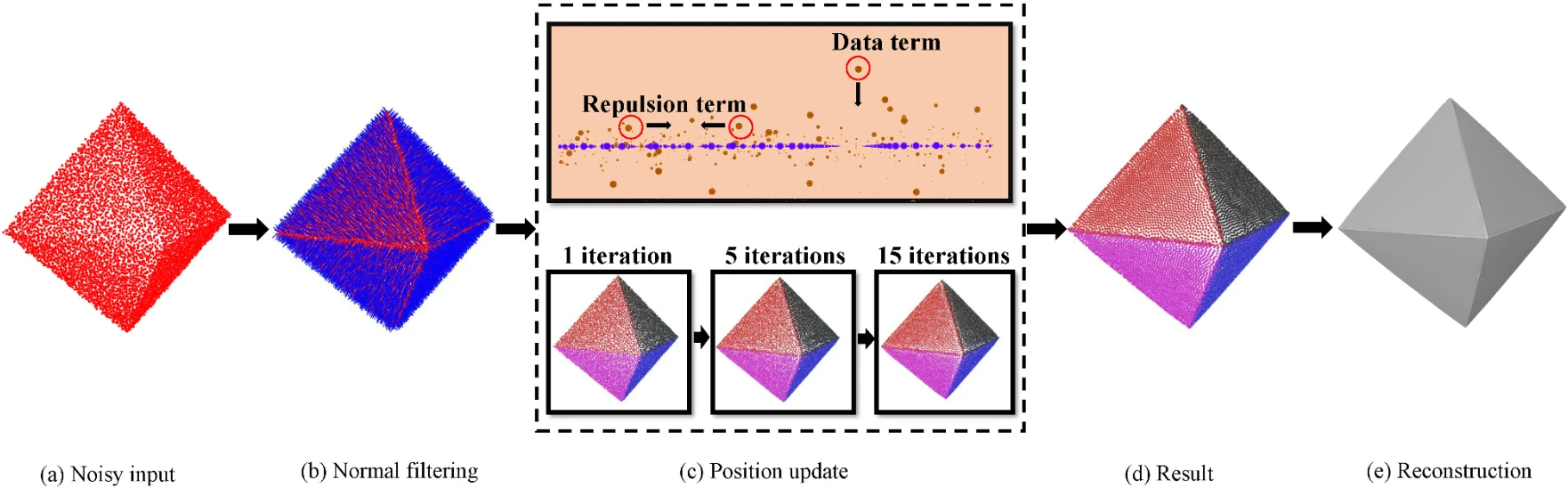
- Noisy input. The input is a noisy point cloud with normals. If it has only positions, initial normals are estimated with principal component analysis (PCA).
- Normal filtering. The normals are smoothed with bilateral filtering. The quality of the filtered points depends heavily on the quality of these normals.
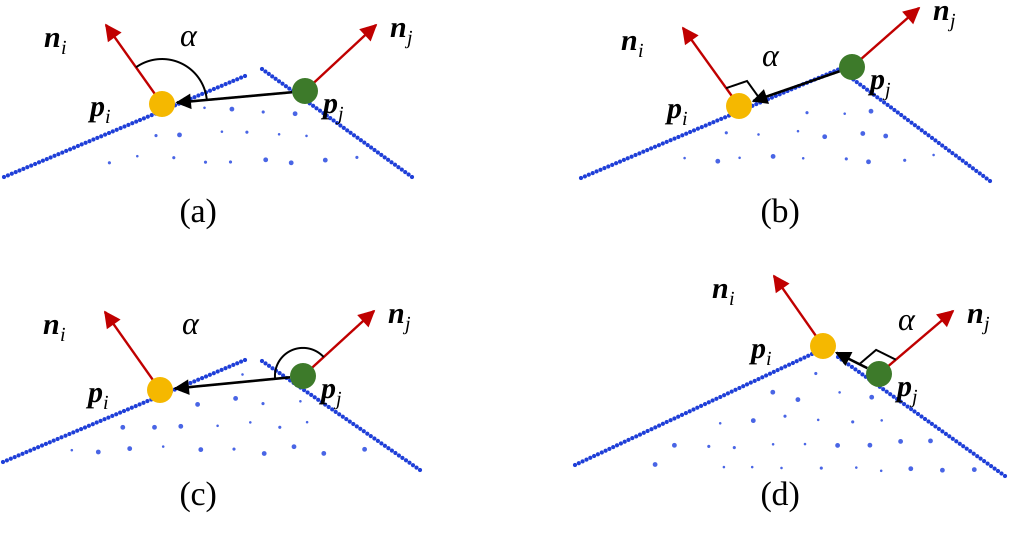
- Data term. For each point and each neighbour in its local patch, the update adjusts the angles between the vector joining the two points and their normals so that the vector becomes perpendicular to both normals. This brings points onto the underlying surface and preserves sharp features, but used alone it moves points towards the edges and leaves gaps.
- Repulsion term. A repulsion term based on point coordinates and normals pushes neighbouring points apart perpendicular to the neighbour’s normal, with a weight that decays smoothly with distance. A parameter µ sets its strength.
- Iterate. Both terms are combined in one gradient-descent update per point (Eq. 6 of the paper), computed on a patch of the k nearest neighbours and repeated for t iterations. Most experiments use k = 30, µ = 0.3 and t = 5 (Table 1).
Results
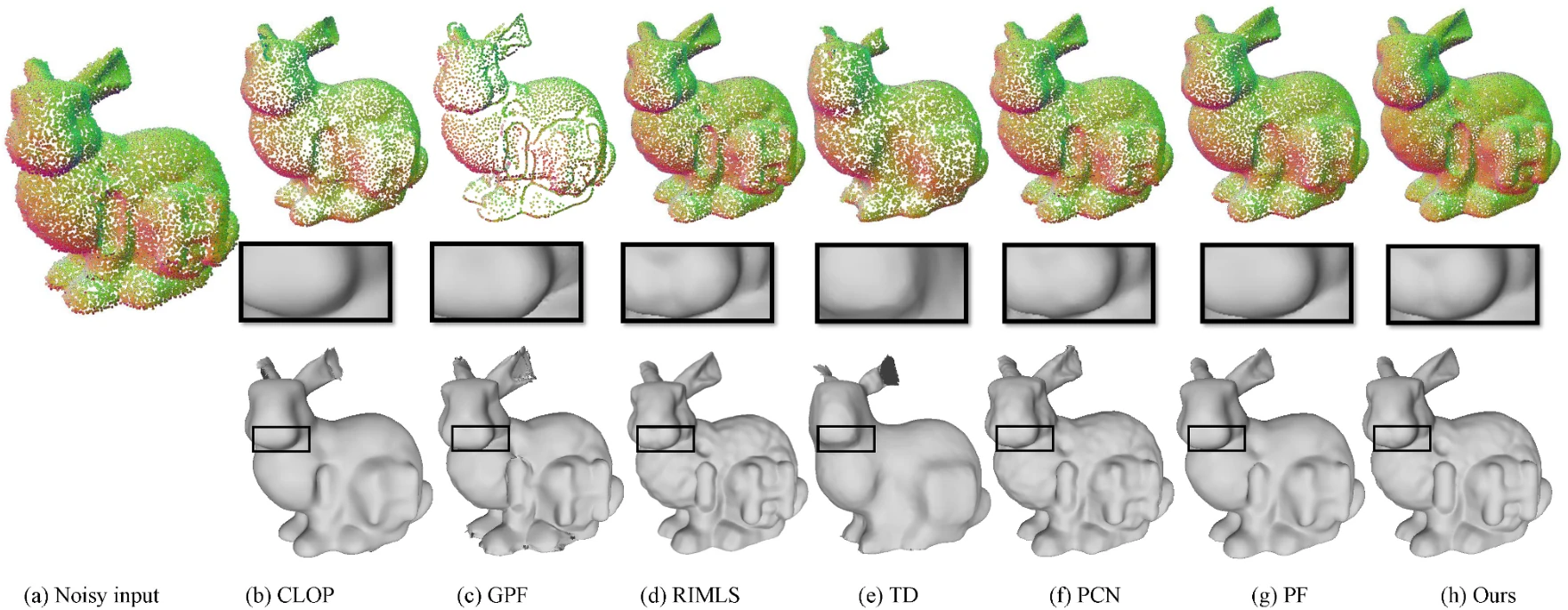
The method is compared with a position-based method (CLOP), two normal-based methods (GPF and RIMLS) and three deep learning methods (TotalDenoising, PointCleanNet and Pointfilter, abbreviated TD, PCN and PF). The quantitative tests use five models with synthetic Gaussian noise of 0.5 % or 1.0 % (Bunnyhi, Rockerarm, Icosahedron, Dodecahedron and Kitten). The method has the lowest Chamfer distance on four of the five models and the lowest mean square error on three. On raw scans (Nefertiti, BuddhaStele, Realscan and David) there is no ground truth, so these are compared visually; the paper reports that its method keeps details such as sharp edges, the steps of BuddhaStele and facial features better than the others. The authors attribute the low errors to the more uniform point distribution: RIMLS, for example, gives comparable visual results in some cases but larger errors in most, owing to its uneven distribution. Without the repulsion term, some points concentrate at the edges.
Further tests cover point density, noise levels from 0.5 % to 3.0 %, irregular sampling, holes and an indoor scene. The authors state two limitations: as a normal-based method it depends on the quality of the input normals, and it may give less desirable results at very high noise (1.5 % is already more challenging than 0.5 % and 1.0 %). Big holes that severely disrupt the surface are also hard to fill, and the best neighbourhood size k depends strongly on point density.
Cite
@article{chen2023towards,
  title={Towards uniform point distribution in feature-preserving point cloud filtering},
  author={Chen, Shuaijun and Wang, Jinxi and Pan, Wei and Gao, Shang and Wang, Meili and Lu, Xuequan},
  journal={Computational Visual Media},
  volume={9},
  number={2},
  pages={249--263},
  year={2023},
  publisher={TUP},
  doi={10.1007/s41095-022-0278-4}
}