Automatic geometric calibration and unwarping of rotating line-scan imaging systems using elliptical distortion of circular patterns
In one sentenceOn a rotating line-scan system, round holes come out as ellipses. This method reads the rotation centre and angular sampling rate from those ellipses, then unwarps 2D images and 3D height maps. No encoder needed.
The problem
A line-scan camera captures one line at a time, and motion supplies the second image dimension. How the image is formed therefore depends on that motion, and calibration has to describe it. Most line-scan calibration methods assume the object moves past the sensor in a straight line. Many inspection systems instead rotate the object: cylindrical workpieces, rotary surface profiling, panoramic imaging of rotationally symmetric parts. Each scan line is then taken at a different angle, a sector-scan (polar) geometry that distorts both the 2D intensity image and the 3D height profile. Calibration methods for rotating scanners typically rely on known angular motion, mechanical measurements or rotary encoders, which add complexity to the system.
The distortion itself carries the missing information. Under rotational scanning, the circular holes of a calibration plate appear as ellipses, and how the ellipses’ centres and aspect ratios change across the image encodes the rotation geometry. Earlier work used circular targets and ellipse fitting, but usually treated the deformation of the ellipses as a side effect of projection or misalignment, not as a record of the scanning geometry.
How it works
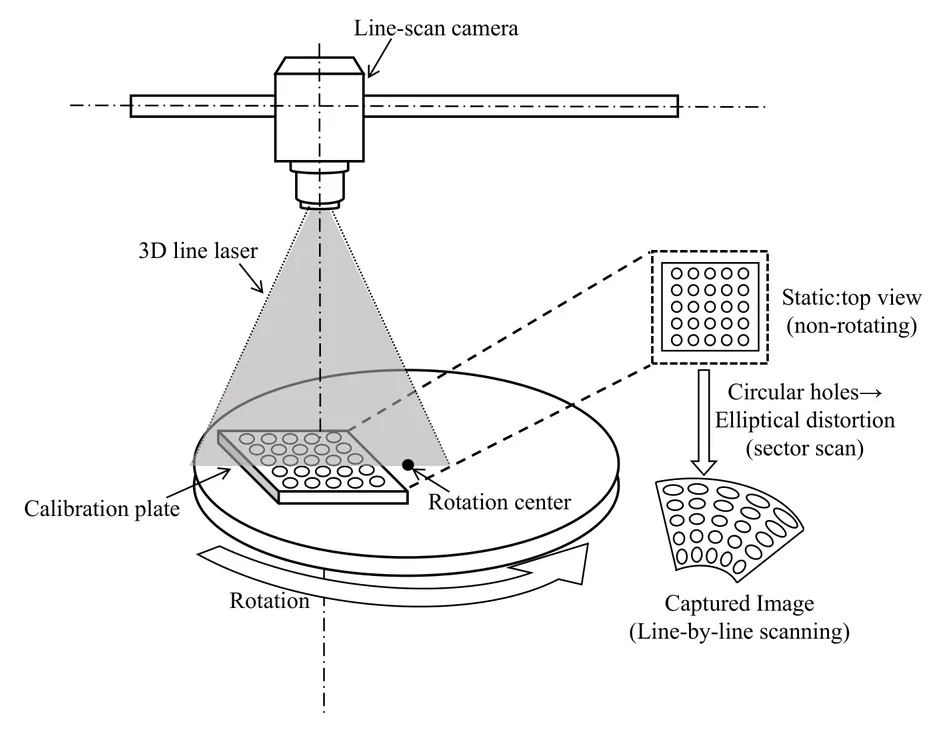
The method treats the image as polar data. A pixel’s column gives its distance from the rotation centre, r = x − xc, and its row gives the rotation angle, θ = k(y − yc), where k is the angular sampling rate in radians per row. The rotation centre (xc, yc) and k are unknown. All three are estimated from the ellipses in an image of a simple circular-hole plate, without encoders, mechanical measurements or auxiliary sensors. One polar-to-Cartesian mapping then corrects the 2D image and the 3D height map.
- Scan. The sensor stays still while the plate turns on a rotary stage. Each scan line becomes one image row at a new angle, so rows record angle and columns record distance from the rotation centre.
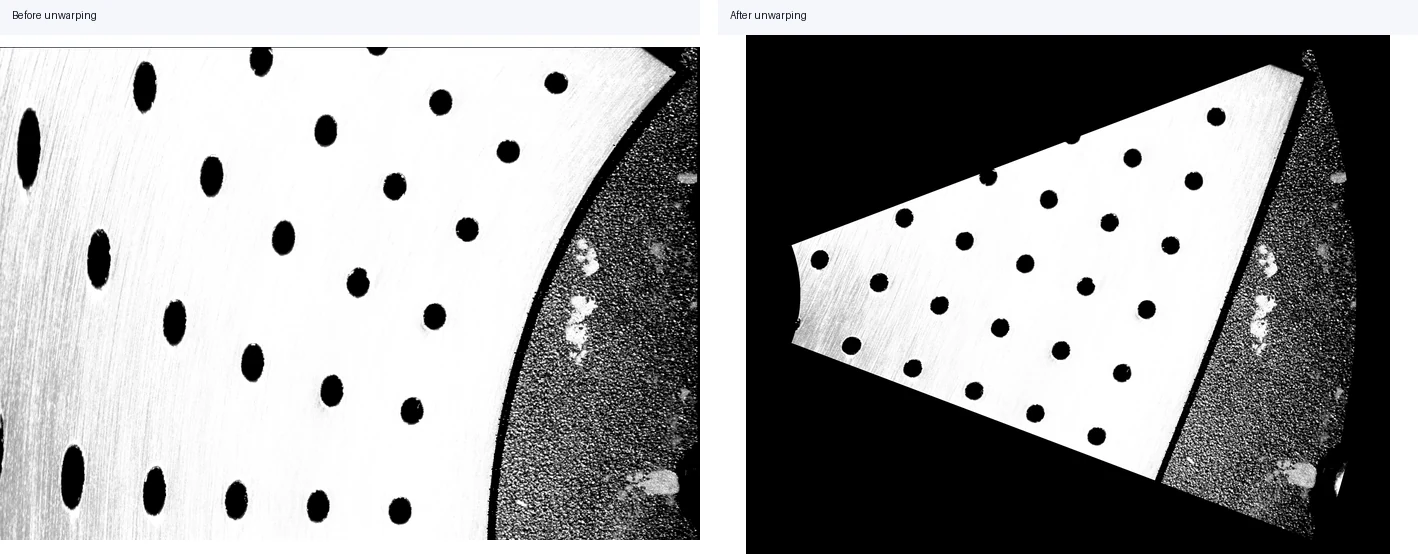
- Circles become ellipses. Under this sector-scan mapping, each round hole appears as an ellipse whose shape depends on its position. A single ellipse may be perturbed by noise, partial occlusion or imperfect edges, but together the ellipses follow stable trends, and the method estimates the calibration parameters from these collective trends rather than from any single precise measurement.
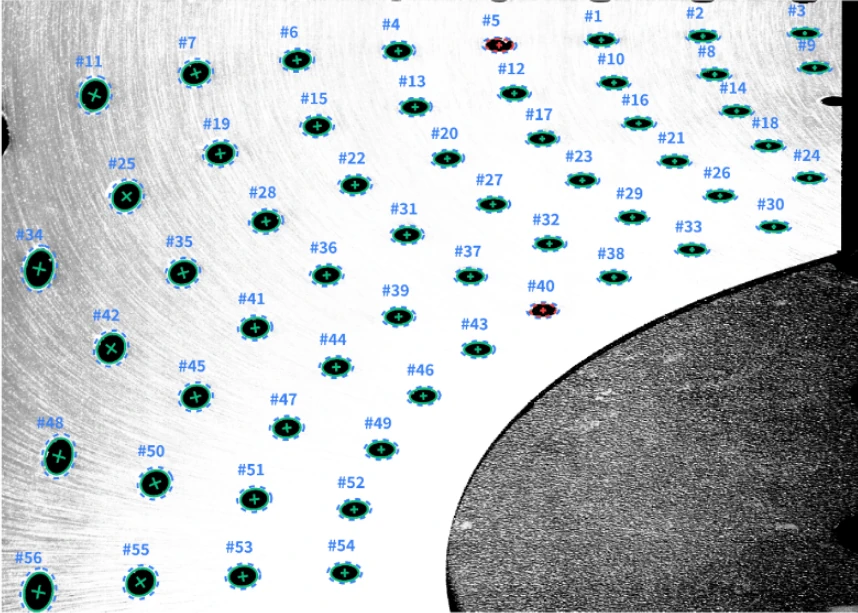
- Fit an ellipse to every hole. Hole regions are located (manually or automatically), segmented with an adaptive threshold, and their edges are refined to subpixel accuracy along the image gradient. After outlier edge points are removed, each contour is fitted with a direct least-squares ellipse fit. The centre and the aspect ratio ρi = rx,i / ry,i are recorded; ellipses with large residuals or unreasonable aspect ratios are rejected.
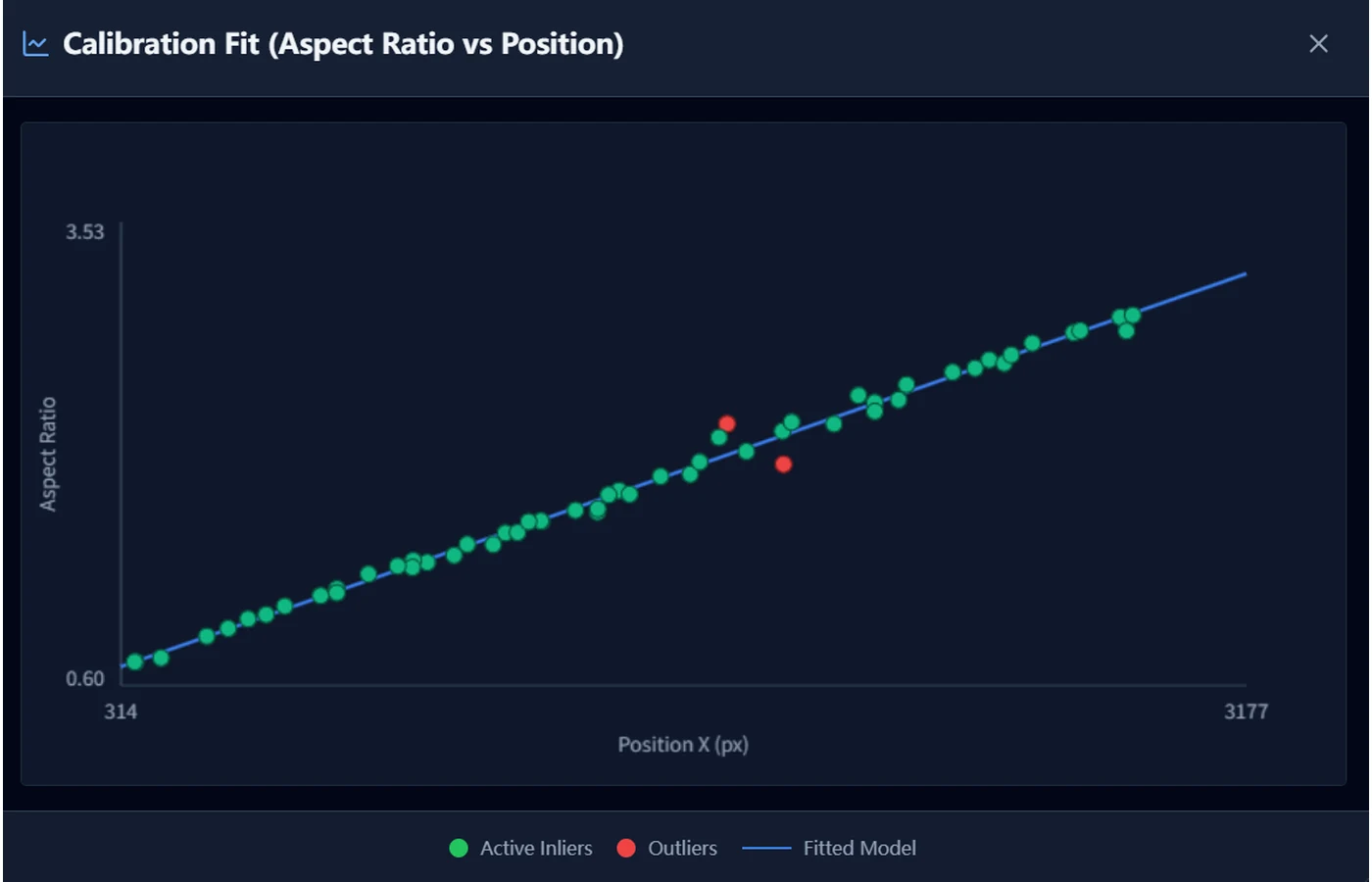
- Regress to find the rotation centre and sampling rate. The aspect ratio varies approximately linearly with the ellipse’s horizontal centre position, ρ = a·cx + b, so the rotation centre is where the line crosses zero, xc = −b/a. Because a small error in the slope a shifts xc strongly, the line is fitted robustly: RANSAC first removes gross outliers, then an iterative residual-based least-squares refinement (ILS) drops measurements with large residuals and refits, typically converging in 2–3 iterations. A second linear regression, of the angle against the vertical positions of the ellipse centres, θ = k·cy + d with d = −k·yc, gives the angular sampling rate k from its slope and the vertical centre yc from its intercept.
- Unwarp. Each pixel of the corrected image is mapped back to the raw image with the estimated xc, yc and k, and its value is found by bilinear interpolation. The ellipses become circles again. For 3D data, each height value becomes a point X = r cos θ, Y = r sin θ, with its height Z unchanged. The laser profiler produces the 2D intensity image and the 3D height map from the same measurements, so one transformation corrects both.
Results
All experiments ran on a real system: a single industrial laser triangulation profiler (LPF2-050, OPT Machine Vision, 405 nm blue laser, 3,200 points per scan line) mounted above a programmable precision rotary stage. The profiler stays still while the calibration target rotates at constant speed, and it records the 2D intensity image and the 3D height profile from the same measurements. Three circular-hole calibration plates of different materials, metallic and ceramic, with different hole layouts, gave consistent estimates of the rotation centre and angular sampling parameters. Ellipse fitting reached an average RMS algebraic fitting error of 0.42 pixels. Unwarping restored the circular holes in the 2D image, and the same transformation reduced residual geometric distortion and improved the spatial regularity of the reconstructed 3D surfaces.
The estimate becomes more stable as more ellipses are used. Over 50 random repeats, the standard deviation of xc fell from 2.1 px with 5 ellipses to 0.6 px with 10 and 0.3 px with 20, and automatic detection with ILS also reached 0.3 px (Table 1). Spreading the ellipses widely across the field of view matters more than adding more of them: the paper recommends about 8–30 well-distributed ellipses covering at least 30–50% of the field of view. The method also stayed stable under simulated partial occlusion, salt-and-pepper and speckle noise, and defocus blur (Fig. 10). When the scanned angle exceeds about 10°, the regression is stable, with R² > 0.99 in most experiments.
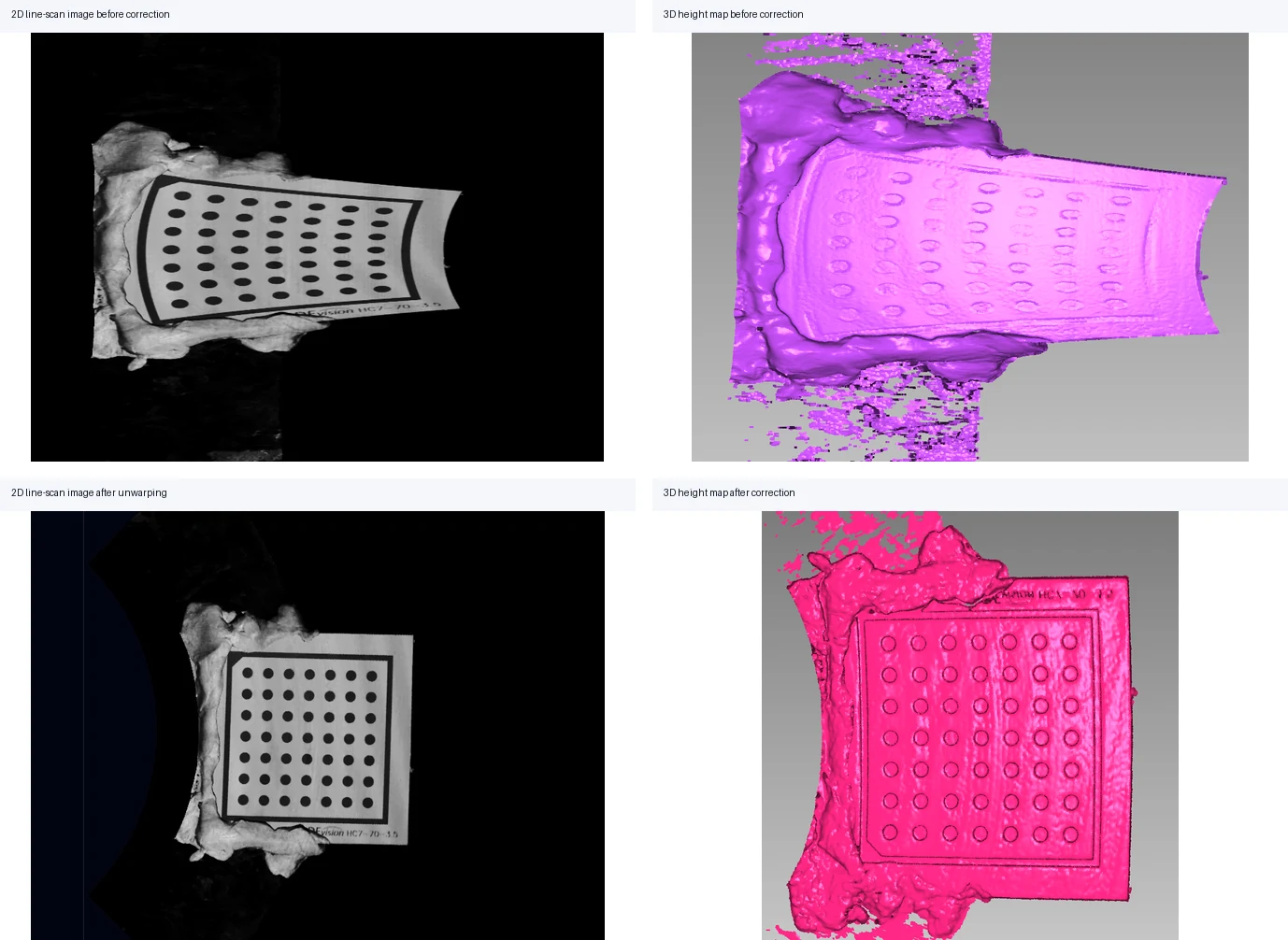
The authors also state the method’s limits. The model assumes the rotation axis is perpendicular to the image plane and that the scan line passes through the centre of the calibration disk; axis tilt, wobble or a lateral offset of the scan line would need extra parameters. Very small scanned angles make the ellipses nearly circular, so xc and k become hard to observe. Strong lens distortion should be corrected first, and a warped or non-planar plate can bias the ellipse centres. For 3D data, the correction addresses distortion from the scanning geometry only; it does not model laser-plane calibration or focal-length variation.
Cite
@article{cao2026automatic,
  title={Automatic geometric calibration and unwarping of rotating line-scan imaging systems using elliptical distortion of circular patterns},
  author={Cao, Ling and Zhang, Wenxin and Feng, Daquan and Pan, Wei},
  journal={Optics and Lasers in Engineering},
  volume={203},
  pages={109793},
  year={2026},
  publisher={Elsevier},
  doi={10.1016/j.optlaseng.2026.109793}
}