Precision 3D volume measurement of transparent adhesives via spectrally optimized line laser scanning and enhanced centroid extraction
In one sentenceClear glue is hard to scan because laser light passes through it. A green-yellow substrate that absorbs the violet laser, plus robust stripe-centre selection, measures dispensed adhesive volume with 1.62% mean error.
The problem
Automated dispensing machines lay down adhesive by dots, lines and coatings in electronic packaging and precision manufacturing. Pneumatic dispensers meter the adhesive through air pressure and valve opening time, and pressure fluctuations make the discharge uneven: too much adhesive overflows, too little leaves weak bonding or poor airtightness. Measuring the volume that was actually dispensed gives the data needed to calibrate the discharge. Manual measurement with calipers is slow and inaccurate, ultrasonic methods are sensitive to material properties and the environment, and electrochemical methods struggle because most adhesives are dielectric. Optical non-contact 3D measurement works well, but mainly for opaque materials.
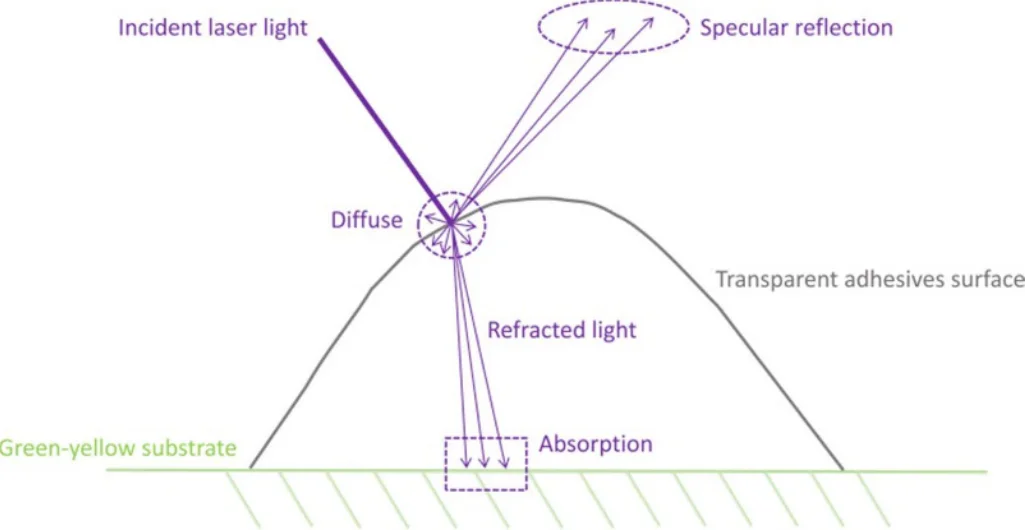
Transparent adhesive breaks the diffuse-reflection assumption behind structured light, photometric stereo and stereo vision. Light is reflected and refracted at more than one surface, the material has no surface texture, and the reconstruction becomes inaccurate or incomplete. Earlier laser-scanning work on transparent objects either relies on complex ray tracing, at a high computational cost, or uses a multi-stage stereo framework that remains sensitive to strong cross-reflections and needs more expensive hardware.
How it works
The system is a monocular line laser scanner: a violet laser projects a stripe onto the dispensed adhesive, a CMOS camera images it, and a mobile robotic platform moves the specimen under the sensor. Camera calibration is automatic. A calibration board on a precision lifting platform is stepped through known heights; at each height the system records a laser stripe image and, with the laser off and a fixed light on, an image of the board. Merging the two gives world coordinates for the stripe centre points, and all camera parameters are then estimated together and refined by maximum likelihood with Levenberg–Marquardt iterations. This replaces the conventional two-stage calibration (at least 15 board poses, then a separate camera-to-laser step), in which errors from the first stage propagate to the second. Each scan then passes through the following steps.
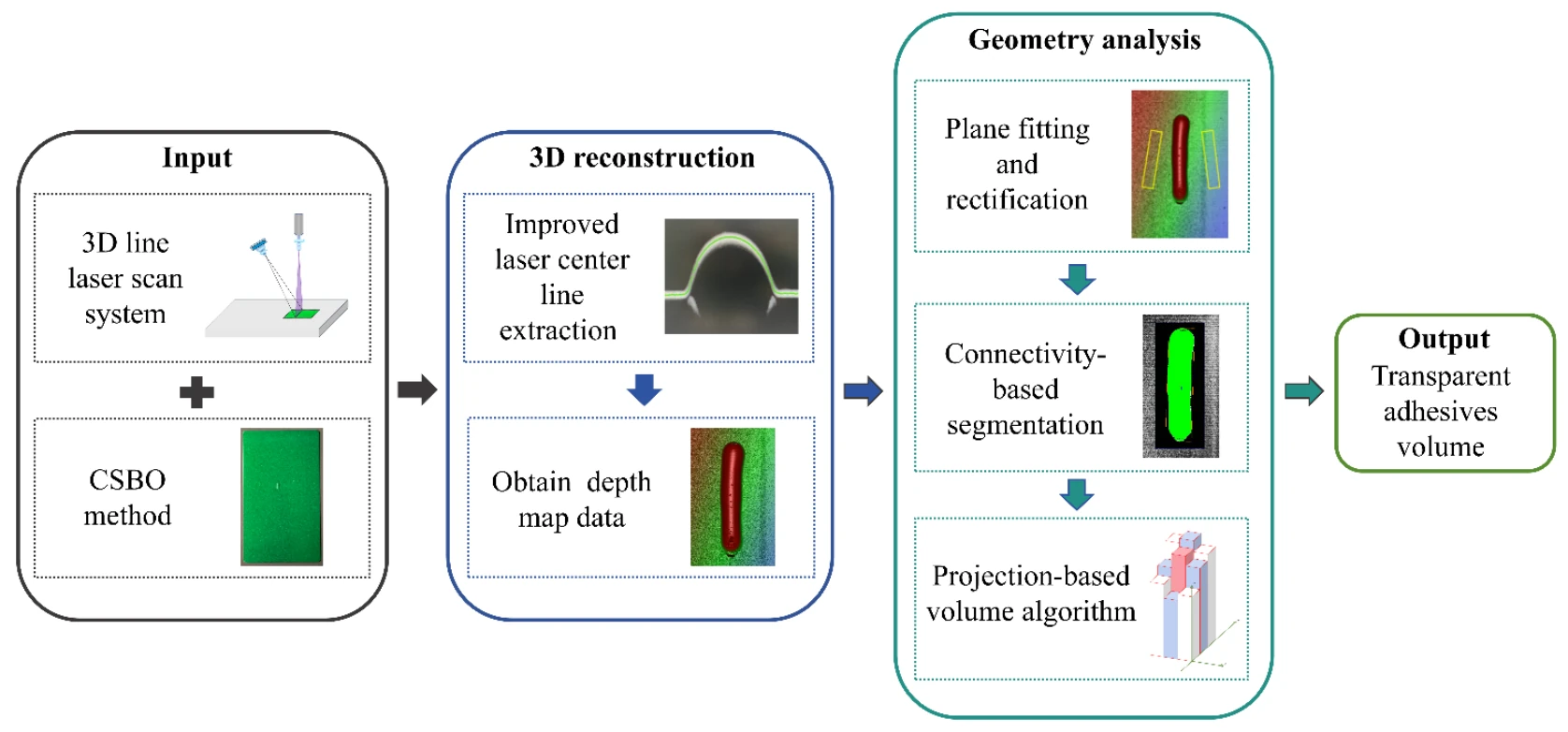
- Complementary spectral background optimization (CSBO). The adhesive is dispensed onto a green-yellow substrate. Green-yellow is the complementary colour of violet, so the substrate absorbs the violet laser light that passes through the adhesive and suppresses the scattering and reflections it would otherwise cause, without ray-tracing models or extra equipment.
- Candidate centre points. Each stripe image is mean-filtered. In every pixel row, a gradient test with direction-consistency checks finds candidate regions where the gray level rises and then falls by at least a threshold K. A gray-level centre of gravity, weighted by w(I) = I / (256 − I), gives one sub-pixel candidate centre per region.
- Dynamic weighted multi-factor scoring (DWMF-SS). Each candidate in a row is scored on continuity (how many neighbouring-row points lie within an offset threshold), gray-level intensity, and closeness to the point kept in the previous row, with weights 0.1, 0.8 and 0.1. Candidates darker than 10% of the brightest candidate in the row or wider than 20 pixels score zero, and the highest-scoring candidate is kept.
- Clean centre line and depth map. A second screening pass after scoring removes anomalous jump regions shorter than a minimum continuity length, and gaps shorter than an interpolation threshold are filled by linear interpolation. The calibration parameters turn each centre line into world coordinates, and all profiles are projected into a depth map of the adhesive surface.
- Volume. A datum plane is fitted by principal component analysis to platform regions of interest, and a rigid-body transformation rectifies the depth map to it. Connectivity-based segmentation (3D Otsu thresholding, run-length encoding, eight-neighbourhood connectivity) isolates the adhesive. Each pixel is treated as a prism of base Δx × Δy and height z, and the volume is V = Δx·Δy·Σz.
Results
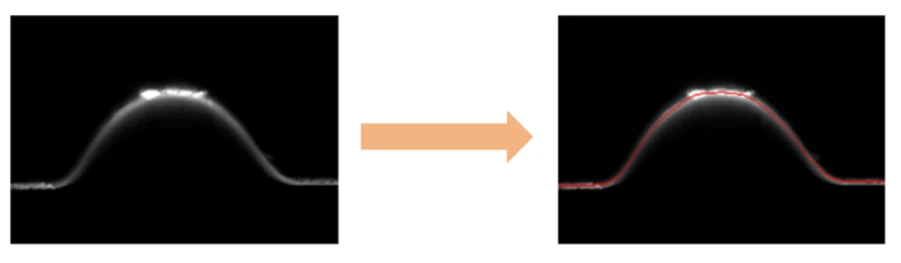
For centre extraction, the methods were first compared on a stripe image with strong edge-diffusion noise from a metallic surface. Steger’s method picked up noise points near the stripe edges, the gray-level centre of gravity failed under the noise, and thinning extracted a skeleton through noise points, while the proposed method gave a continuous, smooth centre line that follows the stripe. Against the true centre line on a calibration board, its RMSD is 74%, 93% and 55% lower than that of Steger, gray-level centre of gravity and thinning. The weights 0.1, 0.8 and 0.1 were chosen by comparing six weight sets on the noisy image. The method is 1.13 times slower than the plain gray-level centre of gravity because it processes extra candidate points, which the authors consider fast enough for industrial real-time use. In their system, an FPGA implementation reaches up to 18 kHz (about 55.6 µs per frame).
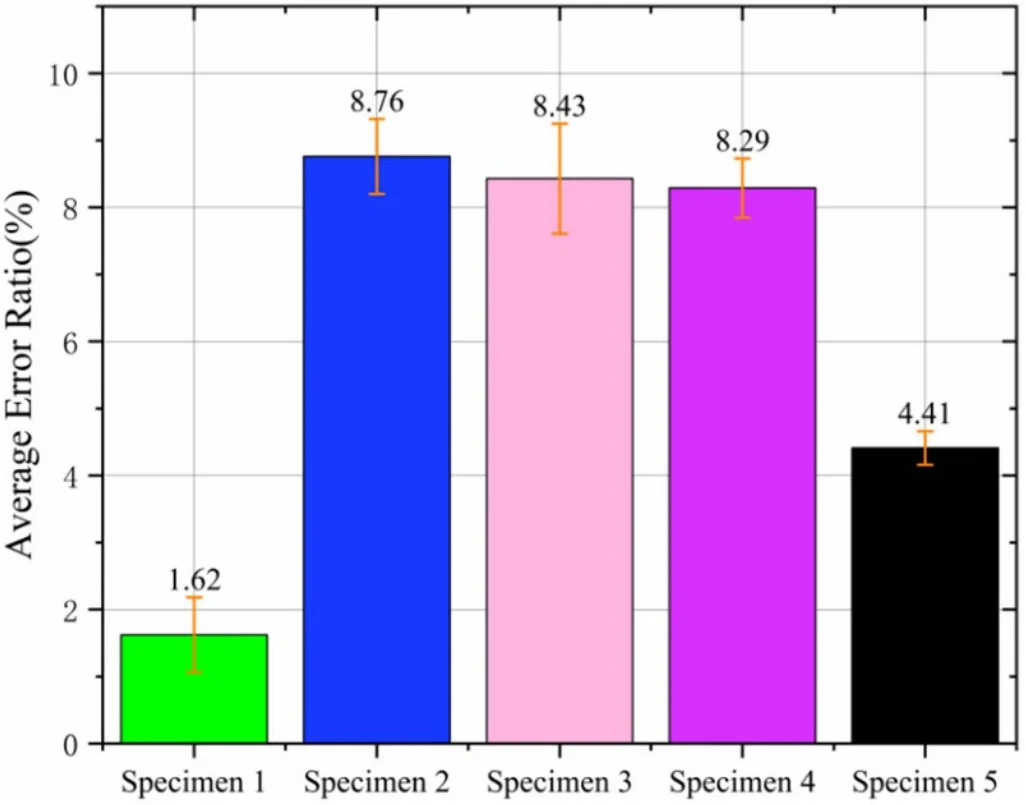
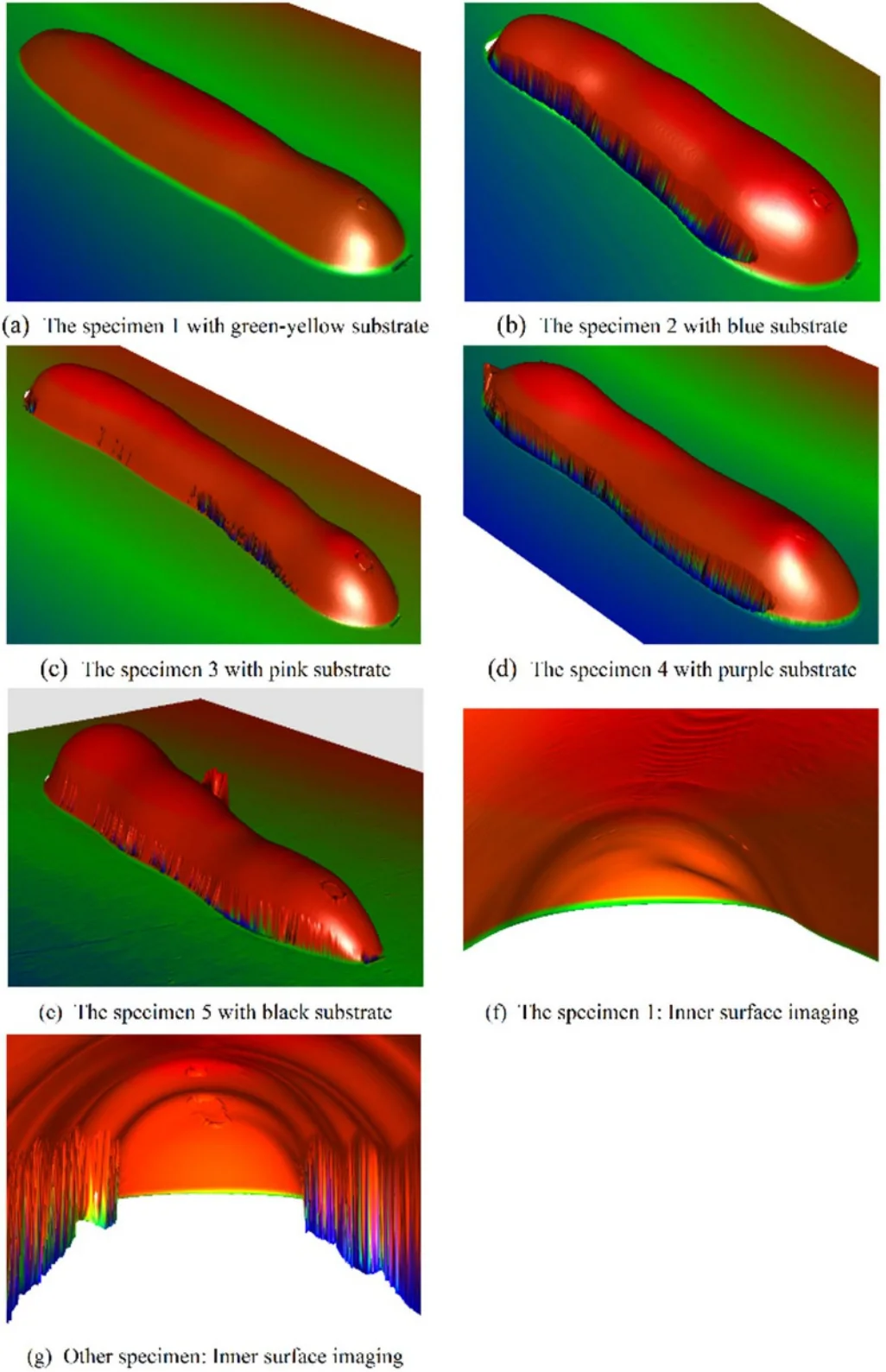
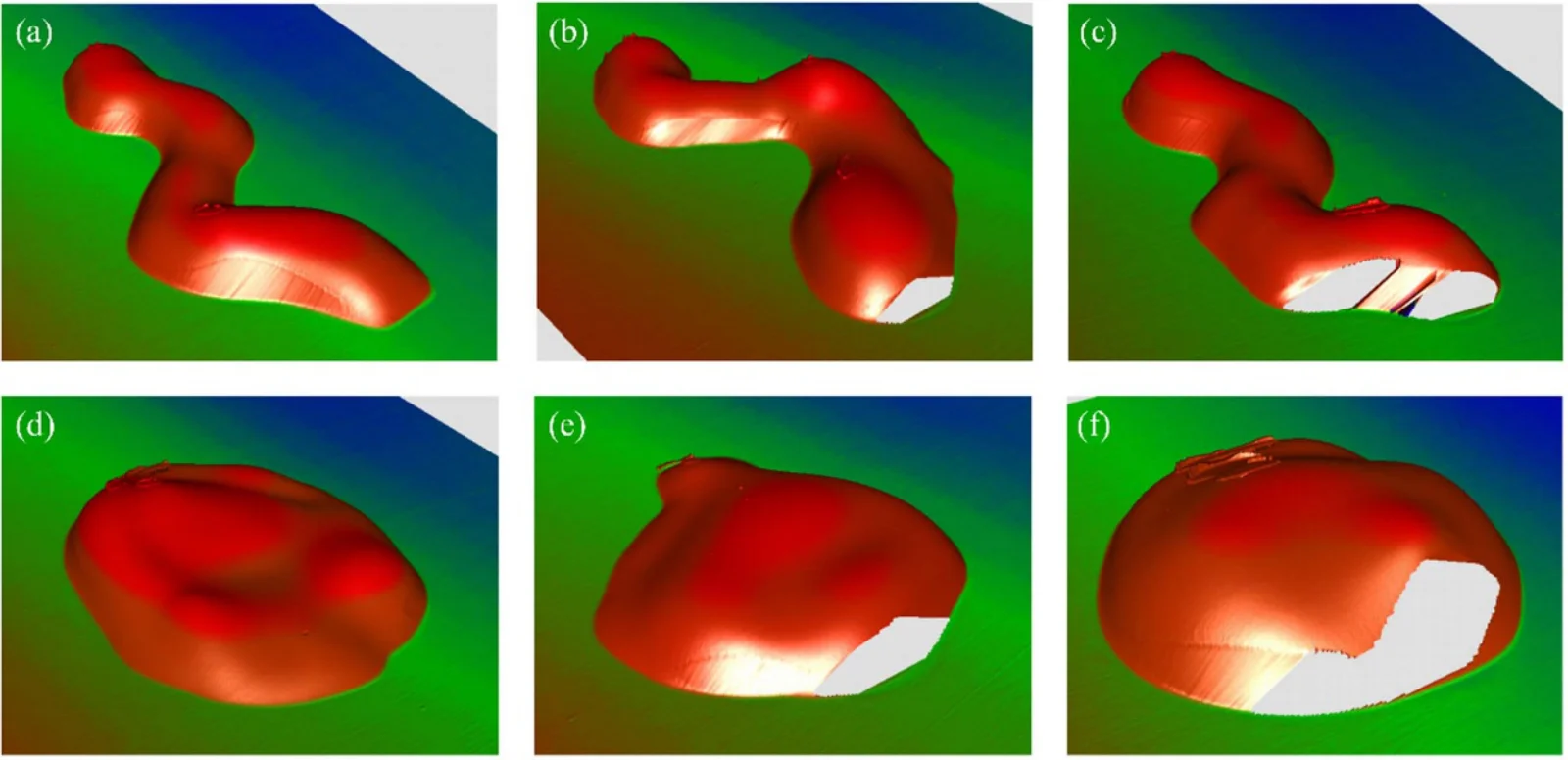
For volume, similar linear beads were dispensed onto green-yellow, blue, pink, purple and black substrates. Each specimen was weighed on a precision electronic balance as ground truth, and the measured volume was converted to weight with a density of 0.0011 g/mm³. Each substrate had five replicates, each measured 20 times and averaged. The green-yellow substrate gave the lowest error, with replicate errors between 1.11% and 2.25%. On the other substrates, the depth maps show varying degrees of surface distortion caused by internal optical interference. Six more complex beads on the green-yellow substrate gave errors of 2.38%, 5.57% and 8.59% for curvilinear patterns and 2.17%, 5.56% and 5.17% for annular ones (Table 5). The larger errors come from surface data missing in the depth maps: when the bead is thick or complex, it blocks the camera’s line of sight to the regions behind it, an inherent limitation of line laser triangulation. The authors point to two scans from different viewpoints as the usual remedy, and plan to extend the system to complex backgrounds and to supplement single-scan data.
Cite
@article{cao2025precision,
  title={Precision 3D volume measurement of transparent adhesives via spectrally optimized line laser scanning and enhanced centroid extraction},
  author={Cao, Ling and Zhou, Renjie and Wang, Xinhua and Pan, Wei},
  journal={Measurement Science and Technology},
  volume={36},
  number={11},
  pages={115206},
  year={2025},
  publisher={IOP Publishing},
  doi={10.1088/1361-6501/ae1a9f}
}